Your Housing Society’s Summer Rulebook — What’s Legal, What’s Not, and What You Can Fight
A notice on your door isn’t a court order. Your RWA secretary isn’t a magistrate. And yet, every summer, millions of Indian apartment residents obey both as if they were. This piece breaks down who gave the housing committee this power — and how you legally take it back.
Downstairs, the generator — running on diesel your maintenance fee pays for — hums away, powering only the lobby lights and the secretary’s flat. The terrace is padlocked. The security guard sweats through a tin booth with no fan. Your landlord just WhatsApped asking for a ₹3,000 rent hike “due to summer demand.”
You stare at the notice. And you wonder: when exactly did this man get so much power over my home?
India’s Resident Welfare Associations wield enormous informal power — but that power has hard legal limits almost nobody knows about. Summer tests those limits hardest because scarcity turns neighbours into adversaries and committees into mini-governments. The rule is simple: a notice from your housing secretary is an administrative communication from a service provider you are paying. It is not law. You have every right to ask on what legal basis it rests.
Every summer, the same drama plays out in apartment complexes across Chennai, Coimbatore, Madurai, Bengaluru, and Mumbai. Water gets rationed arbitrarily. Terraces get locked. Security guards collapse in unventilated booths. Landlords send sudden rent hike messages. And residents — educated, employed, rights-bearing citizens — quietly comply.
Why? Because nobody told them the rules have limits.
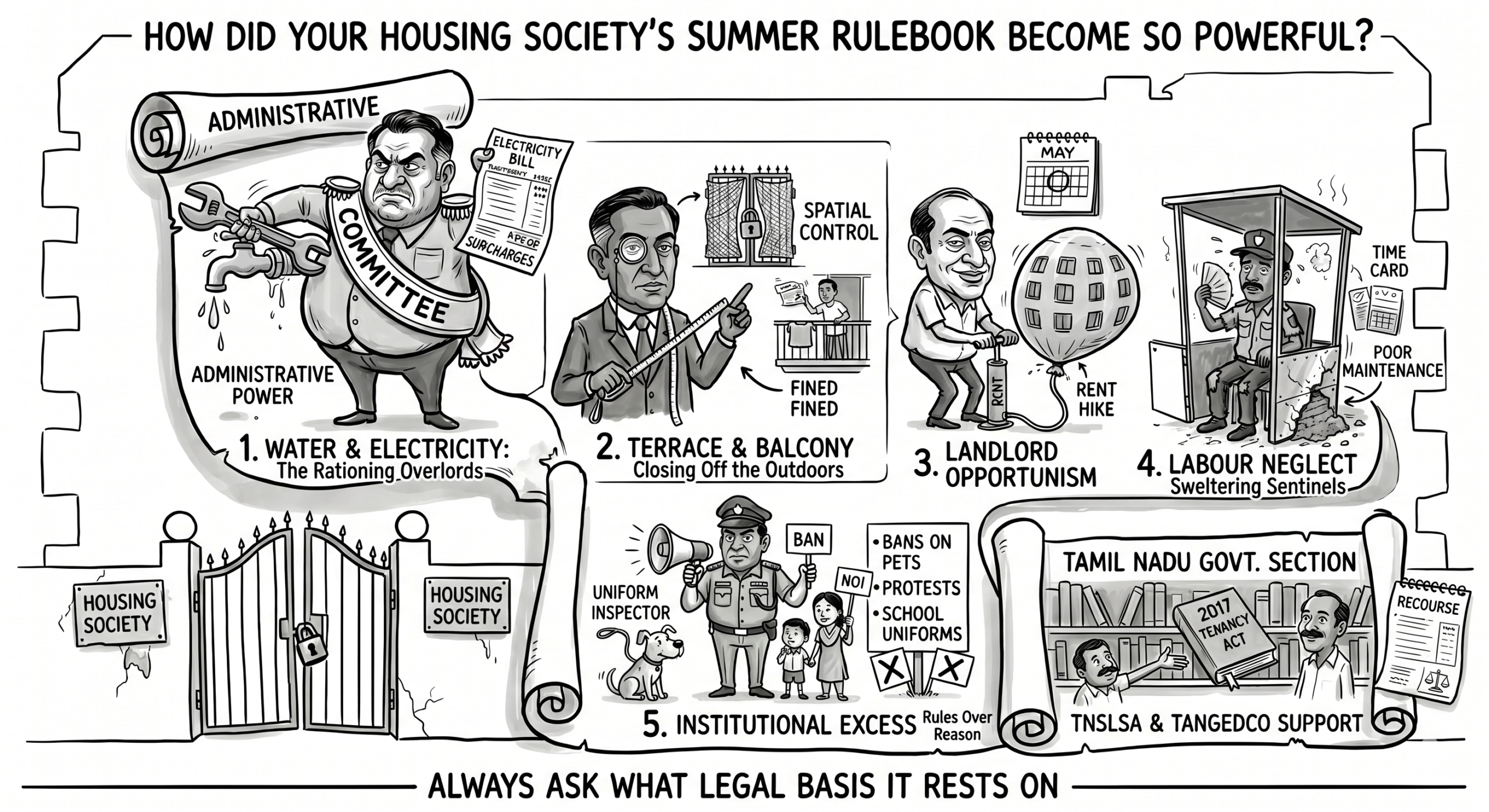
Section 01Why the RWA Rulebook Grew So Large: Five Root Causes
The housing committee’s grip didn’t appear overnight. It grew through a specific set of conditions — legal, social, and structural.
Legal Vacuum at the Local Level
India has national legislation on apartments, but enforcement is state-level and wildly uneven. Most residents have no idea which state law governs their complex. This vacuum gets filled by whoever is most confident — usually the committee secretary.
The AGM Nobody Attends
Every registered housing society must hold an Annual General Body Meeting where rules are formally voted on. Fewer than 20% of eligible residents attend. The committee then makes mid-year decisions — surcharges, bans, fines — with zero democratic backing. Low turnout became a proxy for consent.
WhatsApp as a Governance Tool
A typed notice on a residents’ group — read by 200 people, green-ticked by all — feels official. The format mimics authority. When committees began issuing rules via WhatsApp without citing any legal basis, residents started responding to font-weight rather than legal weight.
Scarcity Creates Emergency Powers
Summer is when water shortages, power cuts, and heat stress make shared resources feel precious. Scarcity normalises rationing — even arbitrary rationing. A committee that cuts water “because of shortage” sounds reasonable. Residents rarely ask who authorised the cut or whether the shortage is real.
Tenants vs. Owners: A Split Community
Most apartment complexes mix flat owners — who can attend AGMs and vote — with tenants who cannot. This creates a class of residents with zero formal representation in the body making the rules they must live by. Committees have historically exploited this gap.
The committee doesn’t just gain power through rules. It gains power through the cost of fighting back. Filing a complaint with the Registrar of Co-operative Societies takes 45 minutes online. Most residents don’t know it exists. The committee knows this asymmetry well — and prices its notices accordingly. The moment residents discover how cheap it is to challenge them, the balance shifts entirely.
Section 02The Water Rationing War — Committee Overreach at the Tap
Water is the first weapon the committee reaches for every summer. Committees threaten to cut a tenant’s supply if they host relatives, exceed an informal quota, or simply irritate the secretary. This is a routine occurrence in Chennai, where the city’s own supply is erratic and apartments run on borewell or tanker water.
Here is what the law actually says. A committee cannot legally cut off water as a punitive measure without a formal general body resolution and due process notice. Under the Tamil Nadu Apartment Ownership Act, managing committees do not have unilateral power to disconnect essential services as punishment.
The flat-rate water billing model — where a one-person household pays the same maintenance as a family of seven — has been successfully challenged in consumer courts as an unfair trade practice under the Consumer Protection Act, 2019, when no sub-metering is provided. If your complex lacks water metres and bills everyone identically, you have standing to contest this.
One more thing about Chennai’s May: PVC pipes running on open terraces heat drinking water to temperatures that leach chemicals into supply. Landlords have a common law duty to provide potable water in habitable condition. Degraded water from overheated pipes is a deficiency of service.
- Screenshot every WhatsApp notice. Save water bills. Photograph pipe conditions. Evidence is everything in consumer courts.
- File with the District Consumer Disputes Redressal Commission if billed on flat-rate without metered usage data.
- Issue a legal notice citing the Tamil Nadu Apartment Ownership Act before escalating — many committees back down at this stage.
- Chennai residents: TWAD Board and CMWSSB both have grievance portals for water quality complaints in registered apartments.
Section 03The Generator Diesel Trap — Spatial Control Through Power
Two injustices arrive together every summer. First: apartment common areas are often metered under commercial electricity tariffs, significantly higher than domestic rates. When summer load surges, this commercial billing gets buried in maintenance fees without explanation.
Second: during load-shedding, the generator kicks in. Diesel bills spike. Committees routinely impose flat-rate diesel surcharges, punishing residents who don’t own AC for the consumption of those who do.
Maintenance fee structures — including diesel surcharges — must be approved at the AGM. They cannot be revised mid-year by the committee alone. Arbitrary mid-summer surcharges without AGM sanction are legally challengeable. Under consumer protection law, charging all residents equally for a resource not equally consumed is an unfair contract term.
Residents also have the right to inspect the electricity connection category of their common meter. If your society is wrongly classified on a commercial tariff, a correction application to TANGEDCO can reduce bills significantly — and that saving must flow back to residents.
- Demand a copy of your society’s Bye-Laws — every registered society must share them on member request. Refusal itself is grounds for complaint.
- At the next AGM, move a resolution for differential diesel billing between AC and non-AC flats. Submit this in writing beforehand so the committee must formally respond.
- If surcharges appear without AGM backing, write to the Registrar of Co-operative Societies, Tamil Nadu. One letter. Public address. The process is that simple.
Section 04The Terrace Lockdown — Who Owns the Sky Above Your Flat?
The padlocked terrace is summer’s most contested space. Committees lock it for “security reasons,” denying residents fresh air when indoor temperatures stay above 35°C even at midnight. In Chennai, this isn’t dramatics — it is a physiological reality during heat waves.
In most apartment ownership frameworks, the terrace is a common area jointly owned by all flat owners. The committee can regulate access — set hours, require sign-ins — but cannot categorically deny access without a valid general body resolution. If the reason is security, the solution is a lockable door with keys available to all residents, not a padlock only the secretary holds.
On shade nets: temporary, removable shading devices — clip-on nets, bamboo chiks, roll-up blinds — that cause no structural change are difficult to prohibit. Some High Courts have held that restricting a resident from protecting their home from the elements is an unreasonable restriction. Permanent structural modifications are another matter and can legitimately be governed by bye-laws.
- For terrace lockdowns: send written notice to the committee citing your co-ownership of common areas. If denied, escalate to the Registrar of Co-operative Societies, Tamil Nadu.
- For shade net bans: retrieve the registered bye-laws and look for the specific clause. Many committees act beyond their documented powers. No clause = no legal teeth.
- For plant drip fines: contest in writing, citing absence of the specific provision in bye-laws. A ₹500 fine without legal basis is an unfair trade practice under the Consumer Protection Act.
Section 05The May Rent Hike — Landlord Opportunism in the Heat
May is when landlords across Tamil Nadu send sudden rent increase notices. The logic is calculated: families with school-going children are least likely to move mid-summer, mid-academic preparation. The summer heat itself becomes a bargaining chip.
It is not illegal to raise rent. But a unilateral mid-agreement revision is not enforceable. The Model Tenancy Act, 2021 — and in Tamil Nadu specifically, the Tamil Nadu Regulation of Rights and Responsibilities of Landlords and Tenants Act, 2017 — requires any revision to be stipulated in the agreement, with three months’ notice before it takes effect.
An oral demand for an immediate hike, or a WhatsApp message threatening eviction if you don’t comply, constitutes coercion under the Indian Contract Act. You are entitled to continue paying the agreed rent until the agreement’s term expires.
The Tamil Nadu Rent Authority, constituted under the 2017 Act, is the specific forum for these disputes in the state. It is faster than civil court and specifically designed for landlord-tenant conflicts.
- Never agree verbally. Respond to any notice via WhatsApp message — this constitutes written communication in Indian law — stating you are bound by the current agreement.
- Keep all rent receipts and the original agreement. Photograph them and store off-device.
- If threatened with service disconnection to coerce a hike, file a complaint with the Tamil Nadu Rent Authority. This coercion is independently actionable.
- Do not vacate under pressure without legal advice. Voluntary vacation may forfeit your right to contest wrongful eviction.
Section 06The Security Guard in the Tin Booth — Labour Neglect as Policy
This is the section that should make residents angry on behalf of someone else. Security guards in Chennai’s apartment complexes work 12-hour shifts in glass or tin booths. No fan. No cooler. No shade. Outside temperature: 44°C. Inside the booth: higher.
RWAs resist upgrading these conditions citing “budget constraints” — the same RWAs that spend freely on lobby lighting and annual day functions.
This is not just a moral failure. It is a legal one. Security guards deployed through contractors are covered under the Contract Labour (Regulation and Abolition) Act, 1970. The principal employer — the RWA — shares responsibility for basic welfare: drinking water, restrooms, protection from extreme weather. Outsourcing through a contractor does not shield the RWA. The Supreme Court has confirmed this in multiple labour judgments.
If a security guard suffers heatstroke while on duty, the RWA faces direct liability. The guard or their family can file compensation claims under the Employees’ Compensation Act, 1923. This is not theoretical — it has happened in Chennai.
- Raise this at the AGM as a formal resolution. Mandate a fan and adequate drinking water as a fixed budget line — not discretionary.
- Submit the resolution request in writing to the committee before the AGM. This creates a paper trail if the committee refuses to add it to the agenda.
- If the RWA ignores welfare failures: write to the District Labour Commissioner. This is a statutory obligation, not a suggestion.
- If a guard suffers heatstroke: direct them or their family to the Employees’ Compensation Act. You may also file a witness complaint yourself.
Section 08Pets, Protests, and School Blazers — Institutional Excess in Summer
Three smaller battles share a common root: institutions using summer heat as a pretext for overreach they couldn’t otherwise justify.
Pet bans from shade zones. Some societies ban pets from shaded common areas during heat waves. The Animal Welfare Board of India’s guidelines and multiple High Court orders are clear: blanket pet bans in housing common areas are not legally sustainable. Reasonable regulation — leash rules, designated zones — is permissible. Categorical exclusion is not. A pet owner whose animal suffers heatstroke because they were denied access to shade can file a complaint under the Prevention of Cruelty to Animals Act, 1960.
Police denying protest permissions citing heat. Can law enforcement refuse permission for a lawful peaceful assembly because it is 40°C outside? The short answer: no — not without specific public health emergency orders in force. Article 19(1)(b) of the Constitution guarantees the right to peaceful assembly. Restrictions must be grounded in specific law, not administrative convenience. If denied, a writ petition at the Madras High Court is the remedy.
School uniform mandates in extreme heat. Schools requiring blazers, ties, and thick socks at 42°C. Child welfare provisions under the Right to Education Act, 2009, and general duty of care principles make it arguable that a dress code posing a health risk to students is actionable. The Tamil Nadu School Education Department has issued explicit advisories during heat waves directing schools to relax uniform requirements. Parents can cite these in formal written complaints to the District Education Officer.
Section 09Why This Matters — The Modern Stakes
India is urbanising faster than its legal awareness is spreading. Over 500 million Indians live in urban areas. Apartment living, with all its shared spaces and collective governance, is now the dominant residential form for the country’s middle class.
The RWA is the most direct form of governance most Indians will ever encounter — closer than the municipal corporation, more intrusive than state government. It affects what residents eat on their terraces, how their pets live, whether their security guard survives summer. And it operates in a legal grey zone where the powerful regularly exceed their mandate because no one asks them to stop.
Climate change makes this more urgent. As Indian summers grow longer and more extreme — heat index temperatures in Tamil Nadu have exceeded 50°C in recent years — the decisions housing societies make about water, shade, and worker welfare become life-and-death questions, not administrative quibbles.
The resident who knows their rights is the only check on a committee that knows you don’t.
ReferenceWhat Your RWA Can and Cannot Do — At a Glance
| RWA or Landlord Action | Legal? | Your Recourse |
|---|---|---|
| Cut water supply as punishment | No | District Consumer Forum / Registrar of Co-op Societies |
| Impose mid-year diesel surcharge without AGM approval | No | Registrar of Co-operative Societies, TN |
| Permanently lock the common terrace | Challengeable | Registrar / Civil Court |
| Ban removable shade nets (if not in bye-laws) | No | Contest in writing; Consumer Forum if fined |
| Demand rent hike mid-agreement | No | Tamil Nadu Rent Authority (2017 Act) |
| Deny security guard basic cooling in extreme heat | No — labour law violation | District Labour Commissioner |
| Blanket pet ban from all common areas | Not legally sustainable | Animal Welfare Board / Madras HC writ |
| Fine for plant drip water (not in bye-laws) | No | Contest in writing citing bye-law absence |
| Refuse to share bye-laws on member request | No | File with Registrar of Co-operative Societies |
| Municipal fine for open waste burning | Yes — comply; contest quantum if disproportionate | Municipal Corporation Grievance Portal / DC Office |