Annamalai’s Masterstroke: How ‘We The Leaders’ Will Crash TVK’s Party
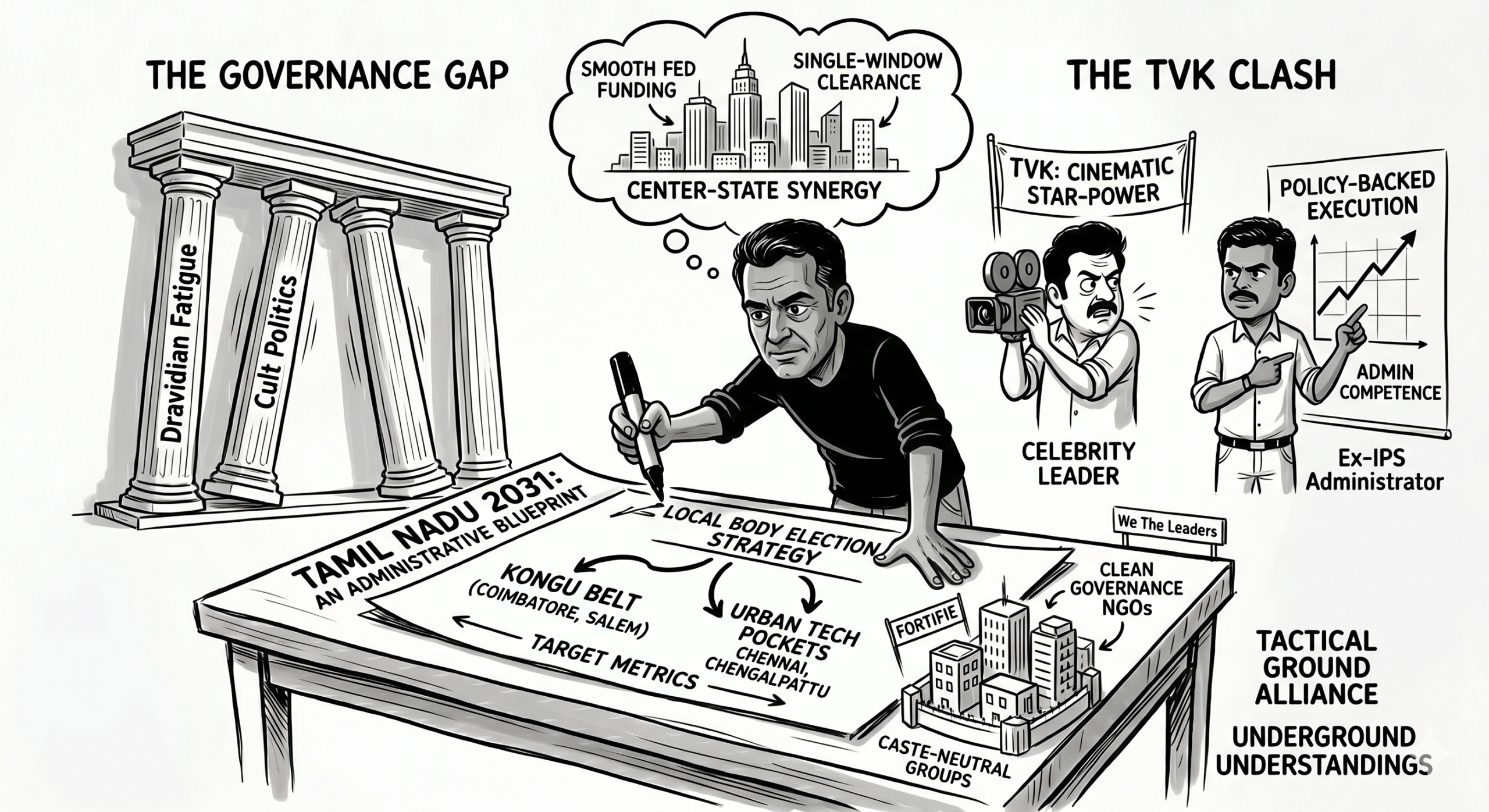
The 2031 Blueprint: How Annamalai Plans to Build from the Ground Up
Everyone said Vijay would destroy Tamil Nadu politics. They were right — but not in the way they expected. TVK’s stunning 108-seat haul in the April/May 2026 Assembly elections didn’t just dent the Dravidian duopoly. It shattered sixty years of political certainty in a single night. And in the wreckage, one man is now quietly drawing a very different map. His name is K. Annamalai. And his plan doesn’t start in 2031. It starts now, in the dust of a hung assembly, in the Kongu belt, in the corridors of panchayat offices most politicians never visit.
This is not a story about a comeback. It’s a story about construction. About someone who watched the old temple fall and decided — instead of mourning it — to design the replacement from scratch.
Can it work? The short answer: possibly, if he wins the local body elections first. The long answer is what you’re about to read.
We The Leaders is Annamalai’s newly launched political movement, formed after his exit from the BJP in June 2026. It positions itself as a technocratic, governance-first alternative to both the Dravidian establishment and celebrity-driven politics. The movement targets grassroots mobilisation through local body elections before pursuing a full state-level push in 2031.
The Governance Gap That Created the Opening
Tamil Nadu has a problem. Not a new one — an old one that festered for too long. Call it Dravidian fatigue. The DMK and AIADMK have traded the state for six decades, each promising transformation, each delivering a version of the same patronage politics dressed in newer rhetoric.
Voters grew exhausted. And exhaustion creates openings.
When TVK arrived, it sucked up that exhaustion brilliantly. Vijay’s star power converted fan loyalty into ballot loyalty. 108 seats is not a fluke. It is a structural signal that voters are willing to leave the familiar behind.
But here is what the headlines missed. TVK won on emotion. Annamalai is betting that governance — not emotion — will win the next election.
This is where Annamalai’s IPS background becomes more than a resume line. An ex-top cop who understands bureaucratic structures, funding pipelines, and administrative bottlenecks is offering something neither Vijay nor Stalin can credibly claim: competence as a platform.
His pitch is simple. Tamil Nadu doesn’t just need new rulers. It needs people who know how systems actually function — and how to fix them when they don’t.
The hung assembly has deepened this narrative. With no single party commanding a clear mandate, administrative paralysis is visible. Infrastructure projects stall. Decisions get deferred. And every delay becomes an advertisement for the argument that Tamil Nadu needs something fundamentally different.
The Local Body Strategy: The Real 2031 Proving Ground
Here is the thing about state elections in Tamil Nadu. You cannot parachute into them. You have to build from below — from panchayat meetings, from ward committees, from the invisible machinery of local governance that most political commentators never cover.
Annamalai understands this. His 2031 plan doesn’t begin with a big rally. It begins with local body elections — gram panchayats, municipalities, and corporations — that most political leaders treat as afterthoughts.
We The Leaders is targeting a presence in 30 to 40 percent of municipal and panchayat union wards. Not to win all of them. But to demonstrate a footprint. To show that this is a real organisation, not a personality cult.
Annamalai exits BJP, launches We The Leaders. Begins Kongu belt grassroots mobilisation.
Local body election campaign. Target: 30–40% ward presence, 12–15% standalone vote share in key zones.
Consolidation phase. Build alliances, expand youth network, develop policy blueprints in governance, infrastructure, and employment.
State Assembly elections. Full 234-seat strategy, possibly with tactical seat-sharing understandings in specific regions.
The target vote share tells you everything about the strategy. Twelve to fifteen percent in targeted zones is not a winning number. It’s a survival number. It’s the threshold above which political commentators stop calling a movement a flash in the pan and start calling it a factor.
Once you’re a factor, alliances come to you. Once alliances come to you, the math of 234 assembly seats starts to look different.
Why the Kongu Belt Is the Smartest First Move
Not all of Tamil Nadu looks the same to Annamalai’s movement. His personal equity is highest in the Kongu belt — the arc of districts that includes Coimbatore, Tiruppur, Erode, and Salem.
This is not an accident. The Kongu belt is Tamil Nadu’s economic engine. It has a thriving MSME culture, a strong Gounder community network, and a history of gravitating toward governance-first politics over pure identity mobilisation. These are voters who want roads that work, power cuts that don’t happen, and clearances that don’t require middlemen.
They are, in other words, exactly the voters Annamalai is speaking to.
Most analysts focus on Annamalai’s local appeal. They miss his structural advantage at the national level. His deep relationships within the Modi-Shah ecosystem mean an Annamalai-led administration could unlock faster infrastructure approvals, smoother federal funding flows, and single-window clearances — precisely the governance wins that Kongu belt industrialists care most about. This is not ideology. It is operational leverage.
Beyond the Kongu belt, the strategy extends to tech-centric urban pockets in Chennai and Chengalpattu. These are younger, more educated, more impatient voters — the kind who read policy documents and roll their eyes at political melodrama. We The Leaders is speaking their language deliberately.
Together, the Kongu belt and Chennai’s tech corridors represent two different but complementary constituencies: established economic confidence and aspirational professional energy. A movement that can unite those two things has something genuine to build on.
Stealing the Youth Narrative from TVK
This is where the political battle gets interesting. TVK controls the youth narrative right now. Vijay’s fan base is young, online, and intensely loyal. After 108 seats, they feel like they’re riding a wave of history.
Annamalai’s response is not to fight that energy directly. It’s to offer a different kind of youth appeal entirely.
Cinema fandom converted into political loyalty
Emotional, identity-driven mobilisation
Star power at the top, uncertainty at the base
Strong on aspiration, untested on governance delivery
Administrative competence as a generational promise
Policy-driven, IPS-backed credibility
Local body roots, not top-down celebrity machinery
Targets youth tired of slogans, hungry for actual change
The argument Annamalai is making — quietly, but consistently — is this: Tamil Nadu’s young people deserve a government that works, not a government that performs.
There is a generation of Tamil youth for whom Rajinikanth’s politics was a disappointment, MGR is mythology, and Vijay is exciting but untested. They are politically curious, institutionally sceptical, and looking for something that feels real. We The Leaders is positioning itself to be that thing.
The local body elections are the vehicle. When young candidates backed by We The Leaders sit in panchayat meetings, fix a water supply issue, or speed up a building permit — that’s the message. Not a speech. An outcome.
Absorbing the Anti-Incumbency That Follows Every New Government
There is a reliable pattern in Tamil Nadu politics. Every new government that arrives on a wave of hope eventually creates its own anti-incumbency. The DMK knows this. AIADMK built its entire existence on exploiting it.
TVK is not exempt. In fact, TVK faces an unusually difficult challenge. It arrived on cinematic star power, which means expectations are proportionally enormous. Real governance — the grind of budgets, bureaucracy, coalition management, and slow institutional change — is going to feel very different from the euphoria of election night.
As TVK navigates the harsh reality of converting a fan base into a governing party, some disillusionment is inevitable. Centrist voters who wanted change but also wanted stability will start to feel anxious. Businesspeople who backed TVK for variety may begin to miss predictability.
We The Leaders is positioning itself to catch exactly these voters. Not by attacking TVK viciously — that would alienate people who still like Vijay personally — but by offering a calm, competence-first contrast. The message is: when the excitement fades, here is where serious governance lives.
The 2031 Alliance Puzzle: Going Solo or Playing Smart
Here is the part of the blueprint that people rarely discuss openly. A solo run across all 234 assembly seats in 2031 is mathematically very difficult. Tamil Nadu’s electoral geography requires either a dominant wave or a smart alliance to cross the majority line.
Annamalai knows this. And we The Leaders’ emerging answer is something that doesn’t have a tidy label: a tactical issue-based front.
The idea is not a grand pre-election coalition. It’s something more surgical. In districts where caste-neutral small parties have genuine ground presence, quiet understandings on seat-sharing. In pockets where clean-governance NGOs have community credibility, informal backing arrangements. Against specific DMK and TVK strongholds, coordinated tactical voting that isolates the major rivals on a constituency-by-constituency basis.
This is less romantic than a formal alliance. But it is more adaptable. It doesn’t require ideological compromises. It doesn’t expose We The Leaders to the reputational risk of being swallowed by a bigger partner. And it preserves the movement’s most valuable asset: its identity as something genuinely new.
An Annamalai-led government would likely recalibrate Tamil Nadu’s relationship with Delhi without abandoning federal cooperation. His history with the BJP machine means he can negotiate directly with the Centre — but his independent platform means he doesn’t have to deliver political favours in return. For a state that has chafed under both Dravidian and BJP federal arrangements, this independence-with-access model could be deeply attractive to voters who want strong state identity without constant Delhi friction.
The alliance strategy also reveals something important about the 2031 blueprint’s deeper logic. Annamalai is not trying to replicate the AIADMK’s formula or the DMK’s machine. He is trying to build something new enough that the old playbook doesn’t apply to it.
That is a genuinely risky bet. But it is also — if it works — the only bet that creates a durable political identity rather than just another cycle in Tamil Nadu’s revolving-door politics.
The Verdict: Blueprint or Mirage?
The honest assessment is this: Annamalai’s 2031 blueprint is coherent, strategically sound, and built on a real gap in Tamil Nadu’s political market. The governance vacuum is real. The Dravidian fatigue is real. The youth appetite for something administratively credible is real.
What is not yet real — what has to be built from scratch in the next five years — is the organisational depth. Local body elections will tell us whether We The Leaders can translate personal equity into institutional muscle. Whether the movement can win without Annamalai standing at every podium. Whether it has roots, not just reach.
The Kongu belt experiment is the litmus test. If We The Leaders can secure 12 to 15 percent of vote share in targeted zones, survive the grind of panchayat-level politics, and hold its identity through five years of opposition, then Tamil Nadu in 2031 will look genuinely different from anything that came before.
The impossible has already happened once this year. TVK’s 108 seats was supposed to be impossible too.
Watch the local body elections. That’s where the 2031 story actually begins.