The AI and Data Centre Boom Is Quietly Draining the Planet’s Water and Power
Every chatbot reply, every image generated, every AI-powered search draws on electricity, water, and minerals. The costs are real — and growing fast.
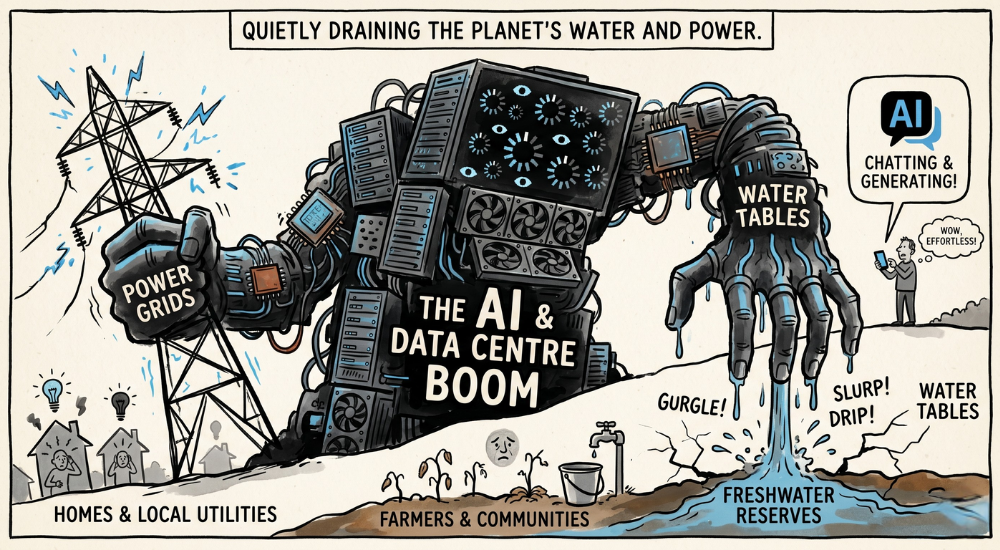
The AI revolution runs on water. Not metaphorically — literally. The servers powering your chatbot prompts need constant cooling. That cooling needs water. And in cities already struggling with drought, data centres are quietly becoming one of the largest competitors for the same resource that farmers and families depend on.
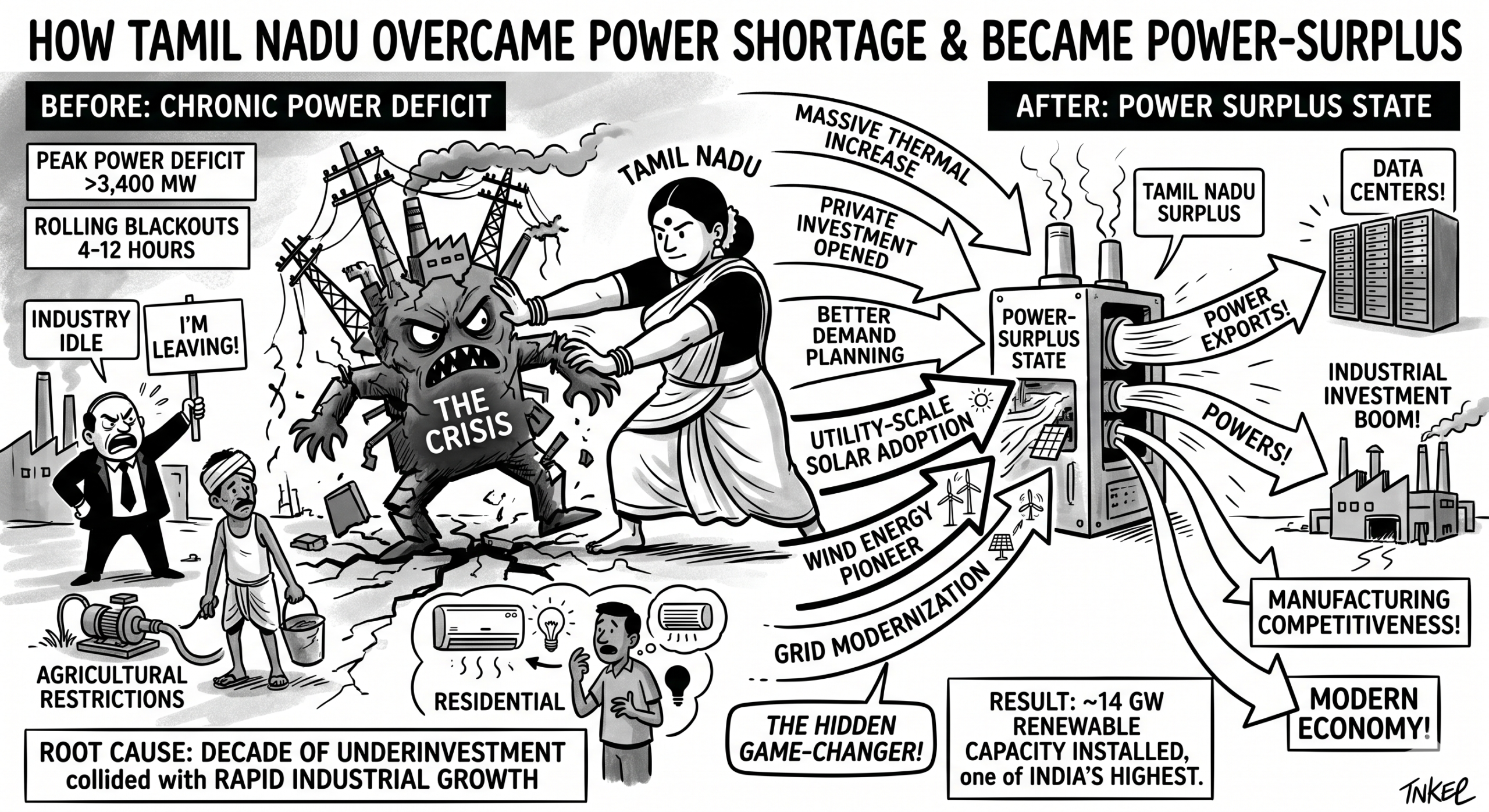
In June 2025, Tamil Nadu’s ruling Dravidian political machinery chose to skip a high-profile national summit on data centre investment — citing sharp localised friction over power and water allocation and what they called federal overreach in infrastructure decisions. It was a pointed gesture. One that may hand a permanent structural advantage back to New Delhi in deciding where India’s next wave of AI infrastructure lands.
That tension is a small window into a much larger story. The AI and data centre boom is creating extraordinary economic value. It is also creating real, measurable pressure on water grids, electricity networks, and the environment. This piece walks through both sides.
What is a data centre, and why does AI need so many of them?
A data centre is a large building packed with servers — powerful computers that store, process, and move information. When you use ChatGPT, Google Search, Netflix, or any cloud-based app, you are using a data centre somewhere in the world.
AI makes this more intense, not less. Training a large language model requires thousands of specialised chips running for weeks. Every single query you send after that — every “write me an email” or “summarise this document” — triggers an inference request that needs computing power to answer.
As AI adoption grows across healthcare, banking, retail, agriculture, and government services, the demand for data centre capacity rises with it. The International Energy Agency (IEA) estimates that global data centres consumed around 415 TWh of electricity in 2024 — roughly the annual electricity use of a mid-sized country.
The AI and data centre boom’s true impact on electricity grids
Electricity is the single largest operating cost — and environmental pressure point — of any data centre. Servers run 24 hours a day, seven days a week, with no downtime.
Traditional cloud computing was already energy-hungry. AI workloads are significantly more demanding. Training a single large AI model can consume more electricity than hundreds of homes use in a year. And inference — answering millions of queries every day — compounds that demand continuously.
The IEA reported that data centre electricity demand grew by approximately 17% during 2025. That growth is not evenly distributed. It concentrates in the cities and regions where data centres cluster: Northern Virginia in the United States, Dublin in Ireland, and increasingly Mumbai, Chennai, and Hyderabad in India.
When a region’s grid is not built for sudden data centre clusters, utilities must either expand generation capacity or manage shortfalls. In Ireland, data centres now consume a large share of national electricity production — a fact that has prompted regulators to pause new approvals near Dublin.
For countries still heavily dependent on coal and natural gas, surging data centre demand can push utilities toward dirtier generation. India currently generates more than 70% of its electricity from thermal sources. Without deliberate policy to pair data centre growth with renewable energy, more AI demand can mean more carbon emissions.
Why data centres are draining freshwater — and why few people talk about it
“A medium-sized data centre can consume roughly 110 million gallons of water annually. Some larger facilities draw millions of gallons per day.”
This is the hidden cost that rarely makes headlines. Electricity gets attention. Water does not.
AI chips generate extreme heat. That heat has to go somewhere. The most efficient way to remove it — especially from dense, high-performance servers — is water cooling. Chilled water circulates through the facility, absorbs heat from the chips, and carries it away. Some of that water evaporates. Some must be treated and discharged.
In data-centre-dense regions like Arizona and Utah in the United States, communities have raised formal objections to new facilities based on groundwater depletion. These are not abstract concerns. Arizona is in a long-term drought. Aquifer levels are falling. And tech companies are arriving with water appetite that rivals agriculture.
Water-efficient alternatives exist — using treated wastewater, seawater loops, or dry cooling — but they cost more to build and operate. Without regulatory requirements to use them, most operators default to municipal freshwater.
The semiconductor supply chain: where environmental costs begin before the data centre is built
Every data centre is filled with semiconductors — the chips that power AI. Manufacturing those chips is itself an enormously resource-intensive process.
A single chip fabrication facility uses ultra-pure water by the millions of litres per day. It consumes large volumes of specialised chemicals. It requires rare materials — gallium, germanium, rare earth elements, high-purity silicon — sourced through mining operations that carry their own environmental footprint.
AI hardware also becomes obsolete quickly. Graphics processing units that were state-of-the-art three years ago are now being replaced by newer, faster models. The old hardware doesn’t disappear — it enters the e-waste stream. The United Nations has warned that AI expansion could significantly increase global electronic waste volumes by 2030.
Most AI environmental impact discussions focus on operational electricity use. The full lifecycle — chip manufacturing, construction materials, transport, and hardware disposal — adds a substantial additional layer of environmental cost that rarely appears in data centre sustainability reports.
What is happening in India — and what the Tamil Nadu episode reveals
India is now one of the world’s most actively courted data centre destinations. The reasons are clear: a fast-growing digital economy, an enormous domestic AI market, competitive land and labour costs, and state governments offering electricity duty exemptions, tax incentives, and single-window approvals to attract investment.
Major hubs are developing in Mumbai, Chennai, Hyderabad, Bengaluru, and Pune. India currently has more than 80 major third-party data centres, and billions in new investment are flowing in. Research by CEEW estimates that data centres account for roughly 0.5% of India’s current electricity consumption and around 150 billion litres of annual water use — both expected to more than double by 2030.
The Tamil Nadu episode is instructive precisely because it is not unique. State governments across India are competing aggressively for data centre investment — offering incentives that sometimes include subsidised electricity and facilitated water access — without always modelling what concentrated data centre demand means for local grids, aquifers, and communities.
The friction that prompted Tamil Nadu to skip the summit was not abstract. It was about who controls the terms of investment, who bears the infrastructure costs, and who decides when local resource limits have been reached. Those are not technical questions. They are political ones.
The economic case is real — and that’s exactly why the stakes are high
None of this is an argument against AI or data centres. The economic case for both is substantial and well-documented.
AI is already improving diagnostic accuracy in healthcare, accelerating drug discovery, enabling precision farming that reduces water and fertiliser waste, strengthening fraud detection in banking, and expanding access to personalised education. Companies including Microsoft, Google, Amazon, Meta, Nvidia, and OpenAI are investing hundreds of billions of dollars into AI infrastructure. AI is expected to contribute trillions of dollars to global GDP over the next decade.
That value is real. And it is precisely because the value is real that the resource costs deserve honest accounting rather than being quietly externalised onto local communities and future generations.
Data centres that consume subsidised electricity pay less than the true cost of the carbon emissions they generate. Data centres that draw freely from municipal water systems in drought-prone cities impose costs on everyone else who depends on that water. Without accurate pricing and clear regulation, those costs remain invisible in corporate sustainability reports — but they remain very visible to the people who live near the facilities.
What responsible AI infrastructure actually looks like
The goal is not to stop building data centres. It is to build them in ways that do not deplete the resources communities depend on. The policy framework for this exists — it simply needs to be applied.
The bottom line
The AI revolution is not just a software story. It is a story about electricity grids, water tables, mining operations, semiconductor factories, and mountains of electronic waste. Every AI prompt has a physical address — a server room drawing power and water somewhere in the world.
That is not a reason to slow AI development. It is a reason to build it honestly. The economic value AI generates is enormous and real. So are the resource costs. The question governments, investors, and communities now face is not whether to build data centres — but whether to build them in ways that leave the water in the ground and keep the lights on for everyone else.
One actionable thought: next time your state government announces a major data centre incentive package, ask two questions. What is the projected water use? And who is paying for the grid upgrade? If neither question has a public answer, that is where the accountability gap lives.