Can Tamil Nadu Avoid the Next Big Power Crisis?
A decade ago, Chennai factories ran on four hours of electricity a day. Today, Tamil Nadu exports power to other states. Here is the full story — causes, motives, and the hidden factor everyone overlooks.
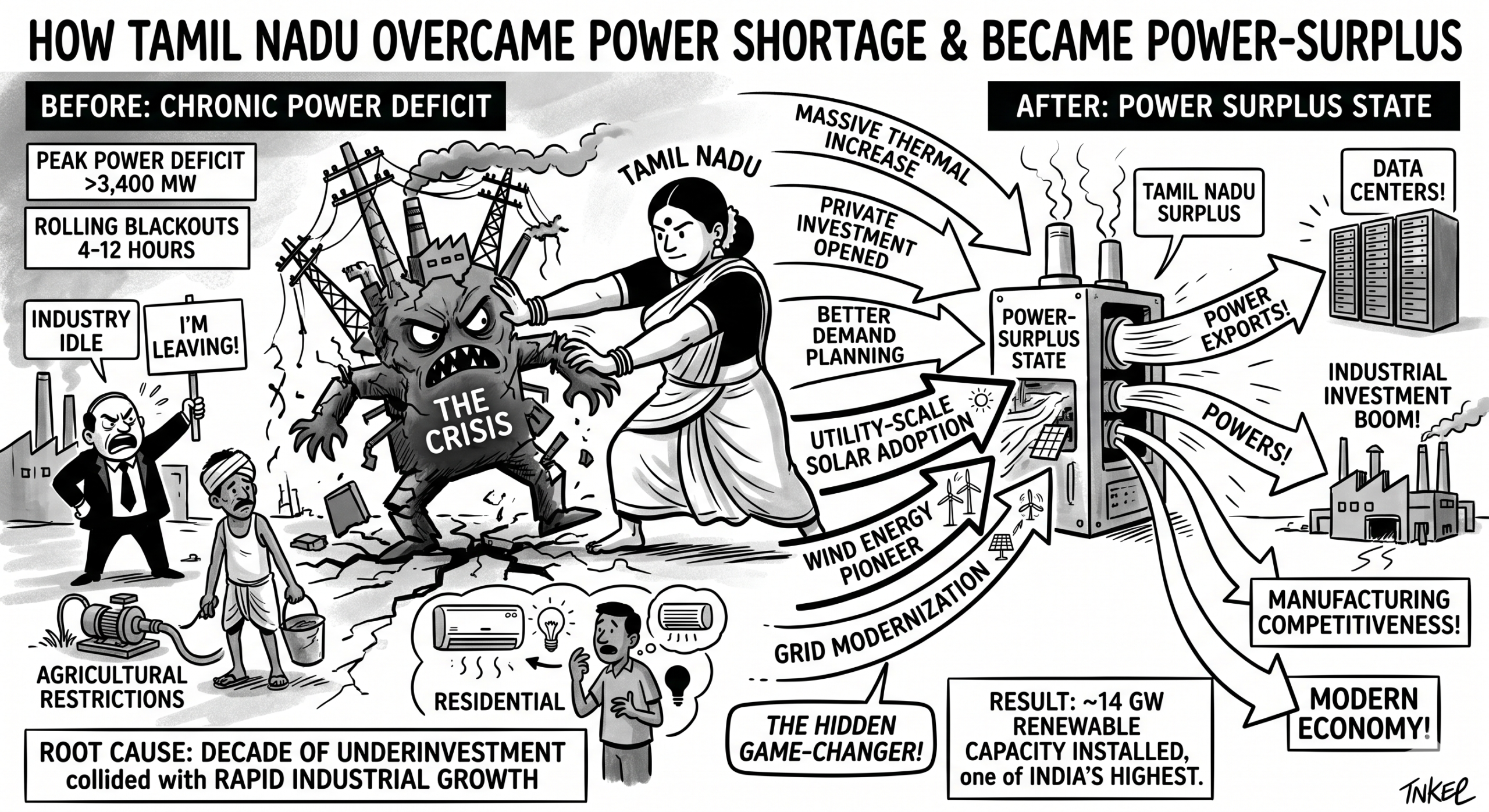
Tamil Nadu moved from a peak power deficit of over 3,400 MW in 2011–13 to a power-surplus position by 2016–17. It did this by rapidly expanding thermal generation capacity, becoming India’s wind energy capital, adopting solar power early, upgrading transmission infrastructure, inviting private investors, and improving long-term demand planning — all at once, not in sequence.
Most people assume a state fixes its electricity crisis by building one big power plant. Tamil Nadu’s story is completely different. The state ran on rolling blackouts for nearly three years. Industries threatened to leave. Agricultural communities faced severe pump-set restrictions. The crisis was real and expensive.
Then something remarkable happened. Within roughly five years, Tamil Nadu flipped from being a power-deficit problem state to one generating more electricity than it consumed on many days. This piece explains exactly how — and why it matters for India’s economic future.
The Power Crisis That Nobody Saw Coming in Time
Between 2010 and 2013, Tamil Nadu experienced some of the worst electricity shortages any Indian state had seen in years. Daily power cuts ran from four hours in cities to twelve hours in rural areas. Industries reported massive production losses. Small businesses cut staff hours. Farmers couldn’t irrigate crops consistently.
The root cause was simple but took years to fix. Tamil Nadu had become one of India’s most industrialised states extremely quickly. Automobile manufacturing in Chennai, textile mills in Coimbatore and Tiruppur, IT parks across the state, electronics factories — all of them needed reliable, high-volume electricity. And they needed it faster than the state could build new generation capacity.
Demand Ran Far Ahead of Supply
Here is a number that explains the crisis in one line: Tamil Nadu’s installed generation capacity increased by only about 483 MW across the entire decade from 2001 to 2010. Meanwhile, the industrial economy was growing aggressively. Residential consumption was also climbing as more households acquired appliances, coolers, and air conditioners.
The mismatch between supply growth and demand growth produced the crisis. It was not a sudden event. It was a slow-motion collision that took years to arrive and required sustained effort to fix.
“Tamil Nadu’s power crisis was not caused by one failure. It was caused by a decade of underinvestment in generation capacity colliding with rapid industrial and urban growth.”
What the Crisis Cost
The economic cost was serious. Industries in Tamil Nadu — particularly automobile parts manufacturers and textile exporters — began evaluating whether to expand operations in other states where electricity was more reliable. That industrial pressure became one of the strongest political motivations to fix the problem fast.
Electricity became a business competitiveness issue, not just a public services issue. That shift in framing is part of why Tamil Nadu responded with unusual urgency and ambition.
Main Causes of the Tamil Nadu Power Shortage
To understand how Tamil Nadu solved its electricity crisis, you need to first understand why the crisis happened. There were five overlapping causes — not one single villain.
Chronic underinvestment in generation
Installed capacity grew by less than 500 MW across an entire decade while demand surged. Planning lagged badly behind economic reality.
Industrial growth far outpaced projections
Auto, textile, IT, and electronics sectors consumed electricity much faster than government forecasters expected. Demand forecasting was too conservative.
Overdependence on single energy sources
Tamil Nadu relied too heavily on a narrow set of generation types with little diversification. Any supply disruption hit the whole system hard.
Weak inter-state transmission links
When local supply fell short, the state couldn’t import enough power from surplus states because the transmission infrastructure wasn’t strong enough.
Limited private sector participation
Private investment in generation was slow. The state relied too much on government projects that often faced delays and cost overruns.
How Tamil Nadu Solved the Power Shortage — Six Strategies at Once
What makes Tamil Nadu’s recovery interesting is that the state didn’t bet everything on one solution. It ran multiple strategies simultaneously. Each strategy solved part of the problem. Together, they produced a transformation.
Strategy 1 — Massive Thermal Capacity Addition
The state’s first and most urgent response was accelerating construction of thermal power plants. New projects were commissioned. Long-term power purchase agreements were signed with independent producers. Central government power allocations were secured. Tamil Nadu’s total installed capacity crossed 24,000 MW by 2016 — a dramatic jump from where it had been just a few years earlier.
These thermal additions gave the state the baseline generation muscle it had been missing. But thermal alone wasn’t the full answer. It was the floor, not the ceiling.
Strategy 2 — Becoming India’s Wind Energy Pioneer
This is where Tamil Nadu’s story gets genuinely distinctive. The state had a natural geographic advantage that most people underestimate: powerful, consistent wind corridors along its southern and western coasts.
Districts like Kanyakumari, Tirunelveli, Thoothukudi, and the Coimbatore hills sit in paths of reliable wind throughout much of the year. Tamil Nadu recognised this early and aggressively courted wind energy developers — domestic and international — with land access, grid connectivity, and favourable tariff terms.
The results were striking. Tamil Nadu became India’s wind energy leader, recording wind generation above 5,500 MW on peak days. Wind power reduced dependence on coal, lowered average power purchase costs during wind season, and diversified the state’s energy mix significantly.
Early 2000s
Tamil Nadu pioneers wind energy in India. Early installations in Kanyakumari and Tirunelveli districts establish the state as a wind-friendly destination for investors.
2010 – 2013
Peak crisis period. Daily power cuts of 4–12 hours. Peak deficit exceeds 3,400 MW. Industrial pressure builds. Policy urgency increases sharply.
2013 – 2015
Thermal capacity additions accelerate. Long-term power purchase agreements signed. Private sector participation expands. Transmission upgrades begin.
2015 – 2016
Solar energy adoption scales up. Utility-scale solar parks commissioned. Tamil Nadu among first states with robust solar policy. Total installed capacity crosses 24,000 MW.
2016 – 2017
Tamil Nadu transitions from deficit to surplus. State generates more electricity than it consumes on multiple days. Around 14 GW of renewable capacity installed — among the highest in India.
Strategy 3 — Early Adoption of Utility-Scale Solar
Tamil Nadu was among the first Indian states to move beyond rooftop solar and commission large utility-scale solar parks. The state introduced solar power policies, encouraged private investment, and signed long-term contracts that gave developers the revenue certainty they needed to commit capital.
This mattered enormously for a specific reason: Tamil Nadu’s peak electricity demand was increasingly happening during the day — driven by air conditioning, commercial activity, and industry. Solar generation peaks at the same time. The match between solar supply timing and peak demand timing reduced pressure on the grid during the hours when it was previously most stressed.
Strategy 4 — Strengthening Inter-State Grid Connectivity
One lesson Tamil Nadu absorbed from the crisis was this: no state can be fully self-sufficient in electricity. When local supply falls short — during plant maintenance, during low-wind periods, during unexpected demand spikes — you need the ability to import electricity from surplus states quickly and reliably.
Tamil Nadu invested heavily in expanding and modernising its inter-state transmission infrastructure. Better high-voltage transmission lines, improved substation capacity, and stronger connections to the Southern Regional Grid gave the state much greater flexibility to import power when needed and export surplus when it had excess generation.
Strategy 5 — Opening the Sector to Private Investment
Government projects alone couldn’t fix the scale of the problem fast enough. Tamil Nadu systematically opened opportunities for independent power producers, wind developers, solar developers, and captive power plant operators. Private investors brought substantial capital — thousands of crores — into the state’s energy sector and often delivered projects faster than government utilities could.
This public-private model became one of the key structural differences between Tamil Nadu’s energy sector in 2013 and its energy sector in 2017.
Strategy 6 — Better Demand Forecasting and Planning
One of the most boring-sounding but genuinely important reforms was improving how the state forecast future electricity demand. Getting this wrong — underestimating how fast industry and households would consume — is precisely what caused the crisis in the first place.
Tamil Nadu invested in better industrial demand modelling, improved peak load forecasting, and longer-horizon generation planning. This reduced the planning gaps that had allowed supply and demand to drift so far apart through the 2000s.
The Hidden Factor Most People Miss
Ask most people what fixed Tamil Nadu’s electricity crisis and they’ll say “thermal power plants.” That’s understandable — thermal capacity expansion got the most political attention and the biggest budget announcements.
The real game-changer was renewable energy — specifically wind. Tamil Nadu’s wind energy programme did not start as a crisis response. It started years earlier, almost quietly, as a policy experiment. By the time the power crisis peaked in 2011–13, thousands of megawatts of wind capacity were already online or close to commissioning. That installed renewable base buffered the crisis and then powered the recovery.
By 2017, Tamil Nadu had installed around 14 GW of renewable energy capacity — one of the highest in India. Renewables were not a supplement to the energy system. They had become the backbone of the state’s new generation mix. Most crisis post-mortems focus on government decisions made during the crisis. They undercount decisions made a decade earlier, during the experimental wind energy phase, which paid off massively when the state needed generation capacity urgently.
There is a second hidden factor: industrial political pressure. Industries in Tamil Nadu are not politically invisible. Automobile manufacturers, textile exporters, and electronics firms collectively employ millions of people and generate a substantial share of the state’s tax revenues. When these businesses began signalling that unreliable power was forcing them to reconsider expansion plans and new factory locations, the political urgency to fix the electricity system increased sharply.
The power crisis wasn’t solved only because of good energy policy. It was also solved because Tamil Nadu’s economic identity was at stake.
Why It Matters — Modern Impact on Tamil Nadu’s Economy
Tamil Nadu’s transition from power deficit to power surplus isn’t just an energy story. It has had direct, measurable effects on the state’s economic trajectory.
| Area | Impact of Power Surplus |
|---|---|
| Industrial investment | Reliable electricity became a key selling point for attracting factories. Tamil Nadu consistently ranks among India’s top states for new industrial investment. |
| Manufacturing competitiveness | Automotive, electronics, and textile firms operate with fewer production disruptions. This improves export quality and delivery reliability. |
| Renewable energy sector growth | Tamil Nadu has developed a domestic wind turbine and solar panel manufacturing ecosystem. The energy sector has become an industry, not just infrastructure. |
| Data centres and digital economy | Tamil Nadu is now one of India’s top data centre locations. Reliable, large-scale power availability is a core requirement for this sector. |
| Agricultural productivity | Farm-sector pump sets now receive more consistent supply, improving irrigation reliability across the state’s agricultural districts. |
The state recently crossed 21,000 MW of night-time electricity demand — a figure that would have been unimaginable during the 2011–13 crisis. But today, Tamil Nadu meets that demand without the rolling blackouts that once defined daily life.
The Next Challenge Is Already Here
Power surplus doesn’t mean problem-free. Tamil Nadu continues to face real challenges: seasonal renewable variability (wind generation drops sharply outside monsoon months), the financial health of TANGEDCO, and the rapid growth in electricity demand driven by air conditioning, electric vehicles, and new data centres.
The state is now attracting semiconductor investments, AI infrastructure, and electric vehicle factories — all sectors with enormous electricity requirements. The question Tamil Nadu must now answer is not how to eliminate power cuts. It has already done that.
The new question is: Can Tamil Nadu build enough clean, reliable, affordable power to sustain the next wave of growth without sacrificing the energy security it worked so hard to create?
Tamil Nadu did not become a power-surplus state because of one project, one government, or one dramatic decision. It happened because of sustained, overlapping investments across thermal generation, renewable energy, private sector participation, transmission infrastructure, and planning discipline — pursued across multiple governments over more than a decade.
The state’s energy transformation shows that solving an electricity crisis is fundamentally an economic competitiveness project. Tamil Nadu moved fast not because energy policy was urgent in isolation, but because its industrial future demanded it.
The lesson for other Indian states is uncomfortable but clear: energy crises don’t fix themselves, and they don’t get fixed by one big project. They get fixed by doing everything at once, sustained over time, with enough political will to keep going when the crisis temporarily eases.