Political Analysis · India · June 2026
The Federalism Brief
INDIA Bloc Crisis · Opposition Politics · Dravidian Federalism
What if the June 2026 DMK Boycott of the National Opposition Meeting Permanently Fractures the All-India Alliance?
When a founding member walks out the door, the question isn’t whether the INDIA bloc is in trouble. It’s whether it was ever really built to last.
What Happened
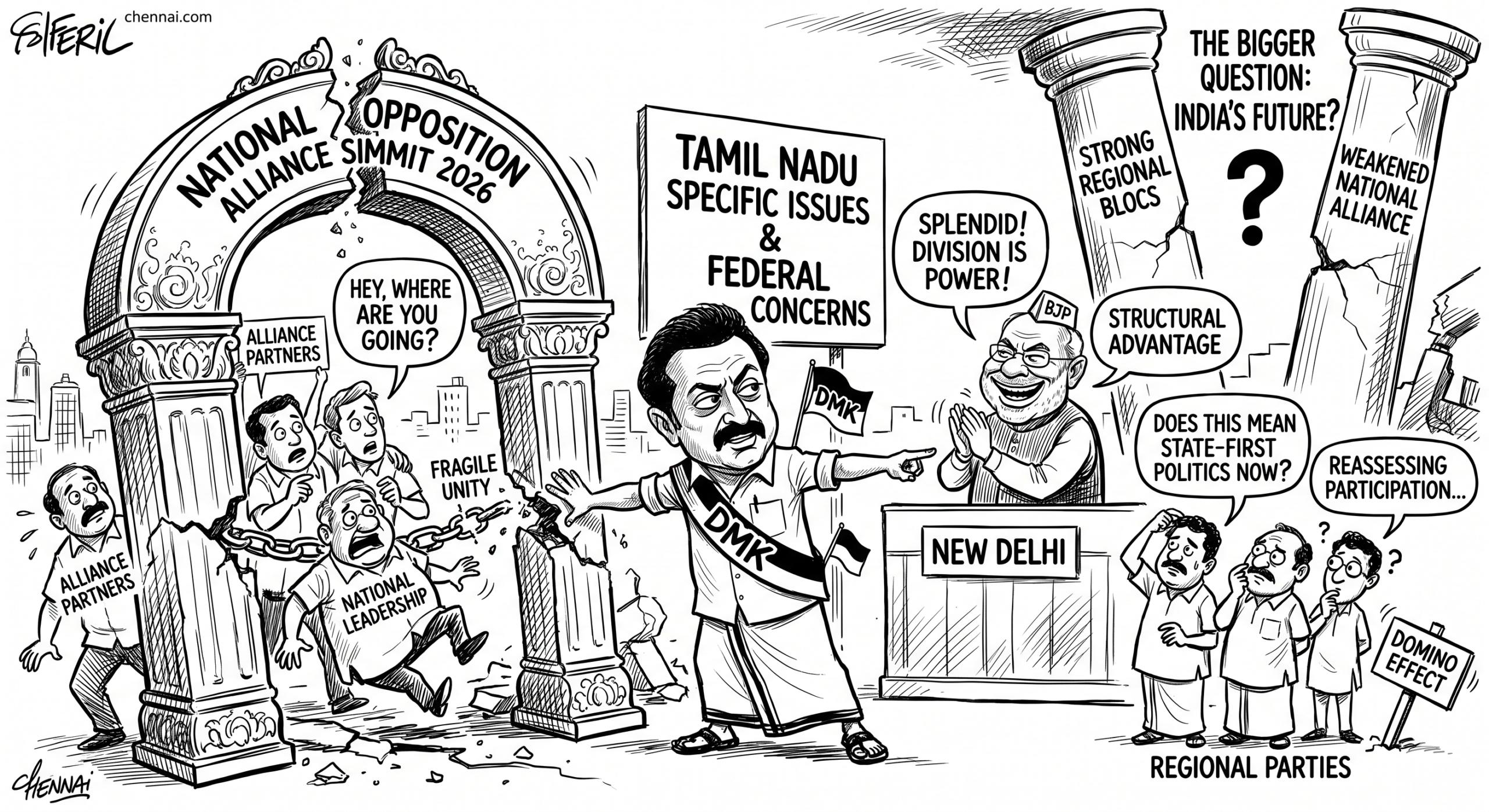
On June 4, 2026, the DMK announced it would skip the INDIA bloc meeting scheduled for June 8 in New Delhi. The reason: the Congress party broke from the DMK-led Secular Progressive Alliance after the Tamil Nadu Assembly elections, choosing instead to align with Vijay’s TVK—the new power in Tamil Nadu. The DMK called it a betrayal. Within days, Sharad Pawar’s NCP also signalled it might stay away, and Uddhav Thackeray’s Shiv Sena was still undecided.
The DMK boycott of the June 2026 INDIA bloc meeting is more than a protest. It is a regional party asserting that national alliances cannot afford to treat state politics as an afterthought. If the fracture holds, it doesn’t just weaken one opposition meeting—it exposes a structural flaw in how the INDIA bloc was always built: on shared enemies, not shared architecture.
The INDIA bloc was built on a simple idea: enough regional parties standing together could match the BJP’s national machinery. It was a coalition of 26 parties, each with their own turf, their own grievances, and their own deal with the voter. For a while, it held. Then Tamil Nadu happened—and the whole structure started to show its cracks.
What looks like a scheduling dispute is actually a deeper argument about power. Who controls the terms of an alliance? Who gets to punish whom when the alliance breaks in a state? And crucially—when a dominant regional party gets hurt at home, does it still owe loyalty to a national coalition?
The DMK boycott of the June 2026 national opposition meeting answers all of these quietly. And the answer is not reassuring for the bloc.
Part One Why DMK Stayed Away—and Why It Had No Choice
The DMK’s stated reason is a sense of betrayal. Congress, which had fought elections alongside the DMK under the Secular Progressive Alliance, watched the Tamil Nadu results—where actor-turned-politician Vijay’s TVK emerged as the dominant force—and made a simple calculation. Why stay tethered to a losing party when the winner was right there?
Congress joined the TVK-led coalition. The DMK, which had just lost six decades of Dravidian dominance in Tamil Nadu to this new political force, watched its long-time national ally side with the very party that had defeated it at home.
From a pure strategic standpoint, Congress’s move was rational. But rationality in politics rarely travels well. In Tamil Nadu’s political culture, loyalty is not transactional—it is symbolic. Breaking that symbolic bond in the aftermath of an electoral loss felt, to DMK cadres, like salt in a wound.
But the boycott was not just emotional. The DMK also had to manage its own internal pressures. Party cadres were furious. An organisation built on Dravidian pride and decades of electoral dominance had just been dethroned at home. For MK Stalin and the party leadership, attending a meeting alongside the party that had openly aligned with the competition would have been an act of political surrender in front of their own base.
The party statement was carefully worded: the DMK would still support opposition efforts on national issues, and it would continue to engage with non-Congress parties. This was not a clean break. It was a public message, aimed as much at Tamil Nadu as at New Delhi.
- Tamil Nadu Elections, May 2026 TVK wins, ending over 60 years of two-party Dravidian rule. DMK loses.
- June 2, 2026 Congress leader Girish Chodankar insists DMK remains in the INDIA bloc.
- June 4, 2026 DMK officially announces boycott of the June 8 New Delhi meeting.
- June 5, 2026 BJP declares the INDIA bloc “dead and buried.” NCP signals it may also skip.
- June 8, 2026 The meeting proceeds—without the DMK, and with several allies absent or undecided.
Part Two The Immediate Impact—Who Changed Their Mind About the Bloc
The BJP moved within 24 hours. National spokesperson Shehzad Poonawalla declared the alliance had “broken into pieces.” Union Minister Giriraj Singh called it a game. The ruling coalition’s messaging was swift and consistent: the INDIA bloc exists only on paper.
This matters more than it sounds. Narrative in Indian politics often precedes political reality. If enough people—voters, journalists, allied parties—start believing the bloc is finished, the bloc struggles to disprove it. Credibility in coalition politics is fragile and self-fulfilling.
Within days, Sharad Pawar’s NCP faction also said it was likely to stay away from the June 8 meeting. Uddhav Thackeray’s Shiv Sena was publicly undecided. These are not marginal parties. Together with the DMK, they represent millions of votes across Maharashtra and Tamil Nadu.
“When a founding member sends an empty chair, every other chair at that table becomes a question.”
The opposition meeting would go ahead. But what was supposed to be a show of unity became a demonstration of absence. The story was not about who attended—it was about who didn’t.
The media narrative had already shifted. Instead of covering the bloc’s agenda or strategy, journalists were covering the DMK boycott, the NCP wavering, and the BJP’s glee. The opposition lost the frame before the meeting even began.
Part Three The Domino Effect—When One Chair Goes Empty
The most consequential risk here is not the June 8 meeting itself. It is what happens in the weeks and months after.
Regional parties watch each other. When one major player demonstrates that it can exit a national alliance without significant cost—and actually gain locally by doing so—others take notes. The DMK’s stand signals something important to parties like the Trinamool Congress, the SP in Uttar Pradesh, and even the AAP: you can maintain your national presence while publicly breaking with Congress on specific issues.
This creates an incentive structure that runs against unity. The INDIA bloc needs its members to show up, make joint announcements, and present coordinated positions. But each member party has a home state where they must appear strong and independent. Every national photo-op with Congress—a party that lost badly in 2024 and has continued to stumble in states—carries a political cost at home.
The DMK’s boycott makes the exit door look respectable. That is the domino.
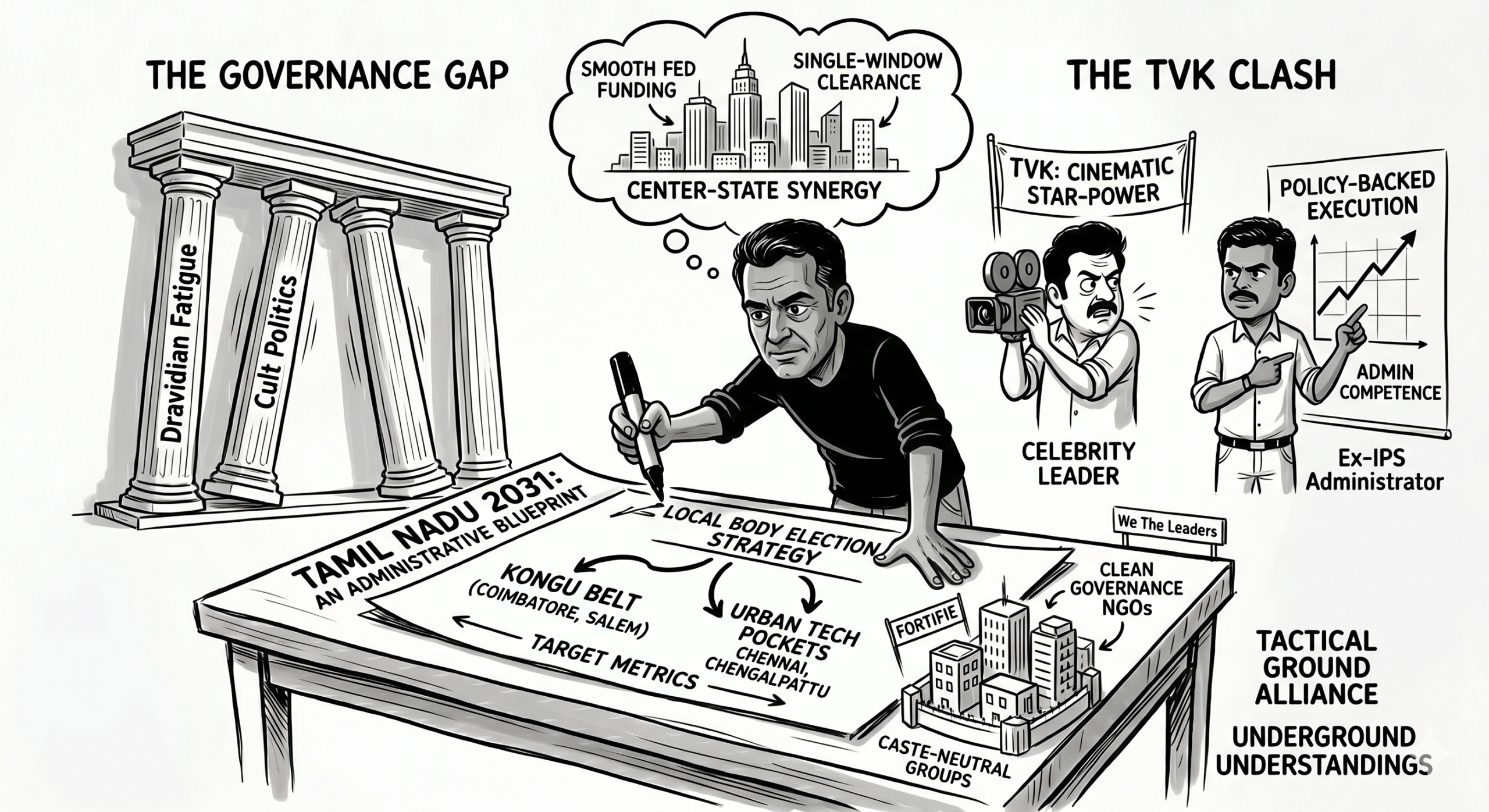
Add to this the rise of what might be called state-first politics. The TVK’s victory in Tamil Nadu is not just a change of government. It is a signal that an entirely new political force, built on regional identity, can displace decades of entrenched power. If voters in Tamil Nadu chose a clean break from the old Dravidian structure, other states may also look at their own entrenched alliances and feel license to disrupt.
Part Four Winners and Losers
Who Gains
BJP and the NDA gain a ready-made narrative: the opposition is fractured, self-serving, and incapable of governing together. Regional parties gain autonomy—they can now push harder for their own terms without fear of being left without a national coalition. TVK gains legitimacy as Tamil Nadu’s new political centre.
Who Loses
The INDIA bloc loses its collective bargaining power with every empty chair. Congress loses its most reliable South Indian partner and faces questions about whether it can hold alliances together. Anti-incumbent voters across states see their opposition fragmented, which directly reduces the probability of a coordinated challenge to the BJP in 2029.
The BJP did not manufacture this crisis. It inherited it. But it will use it. The ruling coalition’s most powerful argument going into the next general election is not economic performance or governance—it is unity. The BJP functions as a single political entity. The opposition functions as a committee. Every fracture in that committee becomes BJP campaign material.
For the DMK, the calculus is different. Staying in the INDIA bloc while Congress sides with their Tamil Nadu rival would have weakened the party at home. Leaving—or at least visibly stepping back—reasserts Dravidian identity and shows cadres that the leadership has pride. In Dravidian politics, pride is not vanity. It is a survival strategy.
Hidden Factor What Most Analysts Are Missing
The real story here is not about betrayal between two parties. It is about the structural impossibility of a coalition that asks regional parties to subordinate their state interests to a national project while Congress—the national anchor—actively makes local deals that hurt those very regional partners. The INDIA bloc was never built around a shared governing philosophy. It was built around a shared opponent. When the opponent is not immediately on the ballot, the coalition has nothing to hold it together. The DMK boycott is the moment that truth became visible to everyone.
India’s federal structure means that state elections and national elections ask completely different questions. A party can be fiercely anti-BJP at the national level while competing bitterly against its INDIA bloc partners at the state level. This has been true since the alliance was formed. But it was always managed quietly, below the surface.
Tamil Nadu brought it above the surface. Congress did not just make a tactical move—it made a state-level decision that contradicted the national alliance’s spirit. That contradiction is now visible, documented, and weaponised by the ruling party.
Going forward, every regional party in the INDIA bloc will have to answer a version of the same question the DMK is wrestling with: at what point does the national alliance cost more than it gives?
Part Five The Bigger Question—Is India Moving Toward Regional Blocs?
Step back from the immediate drama and a larger pattern emerges. Over the last decade, India’s political map has become more regional, not less. The 2024 general election showed that even the BJP’s dominance can be contested when regional parties fight on their own turf with their own agendas. States like Bihar, Maharashtra, and Tamil Nadu have become laboratories for multi-party competition that doesn’t cleanly fit into a two-bloc national framework.
The TVK’s win in Tamil Nadu is part of this pattern. A new party, built around a film star, with a distinct Dravidian and progressive identity, defeated two entrenched political machines that between them had governed the state for over half a century. That is not a coincidence. It is a reflection of a voter base that is increasingly comfortable making local choices that break from national alignments.
If this trend continues, the future of Indian opposition politics may not be a stronger INDIA bloc. It may be a looser arrangement of regional parties that cooperate selectively on parliamentary votes and national issues, while maintaining full independence in their home states. That is not nothing. But it is also not the disciplined, unified opposition that would be needed to mount a serious challenge to the BJP in 2029.
The DMK boycott is, in this light, not a crisis. It is a preview. A preview of how India’s opposition will actually function if no one fixes the structural problems that the Tamil Nadu situation exposed.
Final Thought Why This Moment Matters Beyond the Meeting
What looked like a scheduling boycott is actually a referendum. The DMK is not just protesting Congress. It is asserting a principle: that regional identity, regional loyalty, and regional grievance are not subordinate to national coalition management. That assertion is completely legitimate. It is also, for the INDIA bloc, structurally fatal if it spreads.
The BJP will spend the next two years pointing to June 8, 2026, and the empty chair where the DMK should have been sitting. They will use it to argue that the opposition cannot govern because it cannot even meet. That argument will resonate with voters who want stability, even if they are tired of the BJP.
The INDIA bloc still has time to address this. But it would need to do something it has never really done: build a shared governance platform, create a mechanism for handling state-level alliance disputes, and give regional parties a real stake in the national project—not just a seat at the table, but a role in defining what the table is for.
Whether Congress has the political maturity to do that after what happened in Tamil Nadu is the real question. And the honest answer, watching the events of this week, is that nobody knows.
The Takeaway
What looked like a boycott may actually be a referendum on how India balances federalism, regional identity, and national opposition politics. If the INDIA bloc can’t resolve that tension, it won’t need the BJP to defeat it. It will defeat itself.