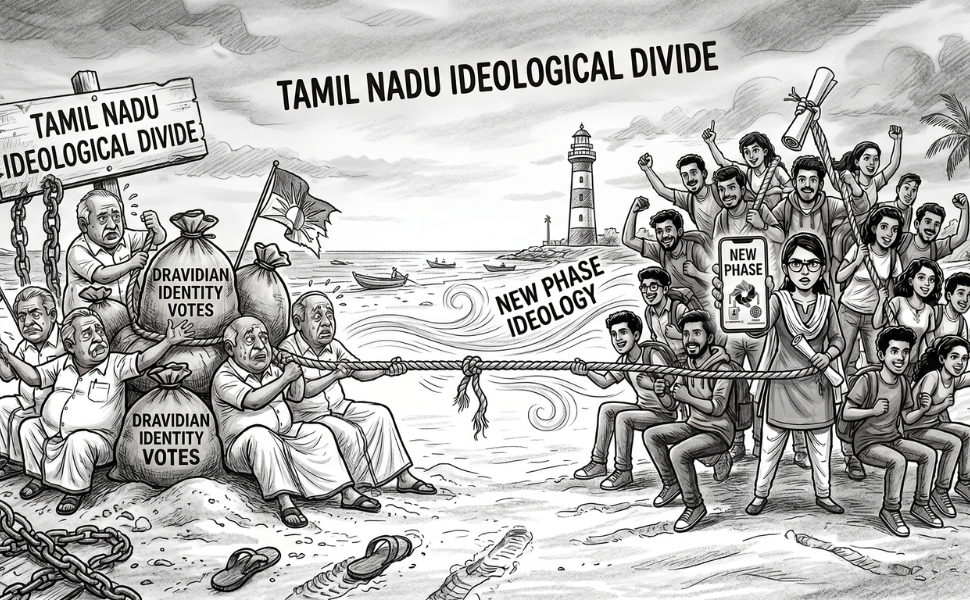
Blog post: Why the 2026 Assembly Election Forced Re-alignments in Dravidian Coalition Math
Tamil Nadu Politics · May 2026
Is this hung Assembly is a new era?
For 59 years, Tamil Nadu ran on a simple operating system: DMK or AIADMK wins, the other waits. That system just crashed. Here is the hard statistical reality behind why it happened — and what no one is saying out loud about what comes next.
The 2026 Tamil Nadu Assembly election produced something nobody thought possible: a hung assembly. TVK — a party that did not exist three years ago — became the single largest party with 108 seats, 10 short of a majority. The DMK, which swept 132 seats in 2021, crashed to 59. The AIADMK held just 47. The two-party duopoly that had controlled Tamil Nadu since 1967 was broken in a single day.
So what actually happened? Charisma played a role, yes. But the real story is structural. It is about voter maths that stopped adding up years before anyone admitted it.
The short answer: 59 years of alternating power breeds fatigue
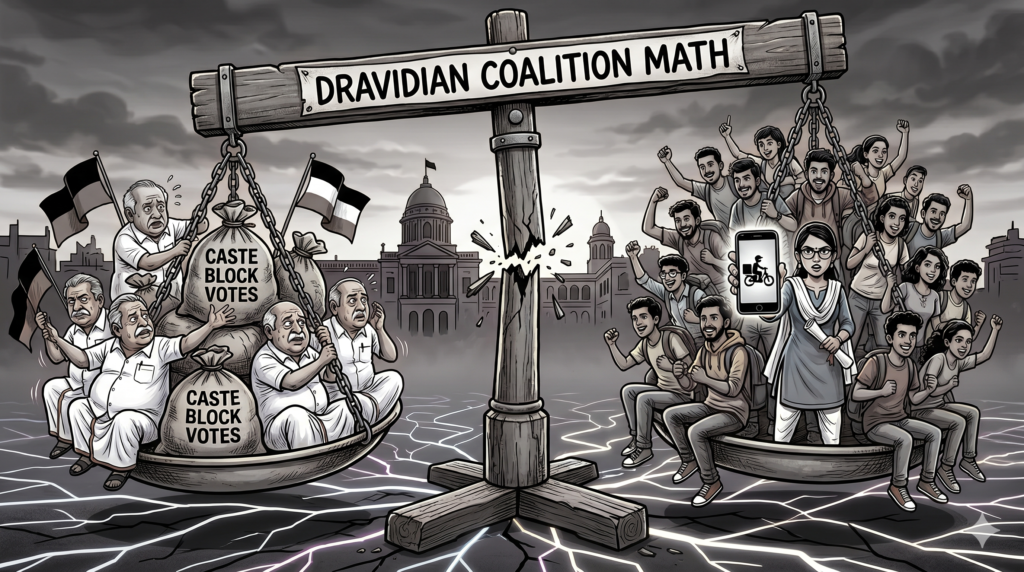
Dravidian coalition math means this: whichever of the two big parties — the DMK or the AIADMK — builds the bigger pre-poll alliance wins. Smaller parties attach themselves to whoever looks likely to win, and they get cabinet seats in return. It worked for decades because voters had no credible third option.
That logic collapsed the moment TVK entered the race with 108 seats’ worth of credibility. The smaller allies no longer had just two doors to knock on. They had three. And that changed everything about how pre-poll alliances were negotiated, how votes were split, and who ended up needing whom.
Cause 1: Anti-incumbency hit the DMK harder than expected
The DMK entered the 2026 election having won every major poll since 2019. That is a remarkable streak. But winning big creates its own problem — promises pile up.
The PMK campaigned on the fact that the DMK made 32 specific promises to Salem district alone, and delivered on none of them. That is not an abstract complaint. That is voters reading a list and ticking boxes. When anti-incumbency has receipts, it travels faster.
The ruling party also faced quiet but persistent pressure from its own alliance partners — the CPI(M), VCK, and Congress — who demanded more seats in the 2026 arrangement. They argued they had fought three elections together and should not be “punished” for standing on principle. That seat-sharing friction drained energy from the alliance before polling even began.
Cause 2: The AIADMK-BJP alliance fractured from the inside
The AIADMK rejoined the BJP’s NDA in April 2025 — 19 months after a messy split. On paper, it looked like a formidable alliance. In practice, it was held together with string.
The two parties disagreed publicly about whether a coalition government should be formed if they won. The BJP’s Home Minister said yes. The AIADMK said no. This was not a minor procedural dispute. It signalled to voters that the alliance did not share a vision of power — only a shared fear of the DMK.
Making things worse, key NDA allies — TTV Dhinakaran and O Panneerselvam — left the alliance, citing EPS’s leadership. Both commanded significant Thevar community votes in southern and central Tamil Nadu. Their exit created vote-share vacuums that Vijay moved to fill.
Cause 3: Vijay did not just split the vote — he restructured it
Tamilaga Vettri Kazhagam contested alone in 233 constituencies. No alliance. No pre-poll deals. That is almost unheard of in a state where coalition arithmetic is the entire game.
Vijay’s strategy was precise. He attacked the DMK and the BJP hard. His criticism of the AIADMK was measured — almost soft. His public message to AIADMK cadres: “You know whom to vote for.” He even sang MGR songs at rallies. He was not trying to be a third force. He was trying to become the primary anti-DMK force, absorbing votes from a declining AIADMK while staying clean of the BJP label.
It worked. TVK’s 108 seats drew from every direction — from first-time voters, from disenchanted AIADMK cadre, from minorities who had loyally backed the DMK for years, and from young urban voters who saw neither old party as credible.
Cause 4: Youth underemployment dynamics changed the voter base
Tamil Nadu has one of India’s highest gross enrolment ratios in higher education. That means a very large number of young, educated voters who entered the workforce over the last decade. And many of them found the job market did not match what the state’s political class had promised.
When you are young, educated, and underemployed, the party that has been in power for five years carries the blame. But so does the party that was in power for the five years before that. The DMK and AIADMK had taken turns governing Tamil Nadu since 1967. A voter born in 1998 had never seen anyone else win. TVK offered them a first vote for something genuinely new.
The turnout numbers reflect this. At 85.1% — the highest in state history — this election pulled in voters who normally sit it out. New participation tends to favour new parties.
Cause 5: The coalition government idea scared Dravidian purists
Dravidian parties have a historical allergy to sharing power. They contest in alliances but always intended to govern alone. That is a point of ideological pride — the idea that the party, not a coalition, runs Tamil Nadu.
When Amit Shah announced publicly that the NDA would form a coalition government in Tamil Nadu under the AIADMK, he put his ally in an uncomfortable position. AIADMK leaders scrambled to clarify. Their own cadre were confused. If you are an AIADMK voter who believes in Dravidian governance principles, hearing that your party might share the chief minister’s office with the BJP is not a selling point. It is an alarm bell.
The hidden factor: what people miss
Everyone talks about Vijay’s star power. Almost nobody talks about the structural exhaustion of the alliance system itself. Tamil Nadu’s smaller parties — PMK, VCK, CPI(M), DMDK — had spent years demanding more seats, more ministerial weight, more recognition. They were told to be grateful for being on the winning side. In 2026, for the first time, they had a third door. Some walked through it. When the glue that holds a coalition together is not shared ideology but shared fear of the other side, all it takes is a credible alternative to dissolve the whole arrangement.
Why it matters: Tamil Nadu enters coalition era for the first time
The 2026 result delivered Tamil Nadu’s first hung assembly. That means government formation now requires negotiation — something the state has never had to do at the assembly level. TVK needs 10 more MLAs to reach majority. Every party in the assembly has leverage it never expected to have.
For coalition math, this is a complete reset. The DMK, now in opposition with 59 seats, has to recalibrate its identity from ruling party to accountability actor. The AIADMK, which has not won an election since Jayalalithaa’s death in 2016, now holds just 47 seats and has lost its status as the principal opposition to the DMK itself.
The parties that always played junior partners now have real bargaining power. The PMK, VCK, and others can choose whom to support in a government formation — and they will extract something meaningful in return. The era of one Dravidian party commanding 130-plus seats and calling every shot is, at least for now, over.
Final thought
The 2026 Tamil Nadu election is being read as Vijay’s triumph. It is. But it is also the story of two parties that governed alternately for nearly six decades and slowly ran out of new things to offer. Voter fatigue is not a sudden event. It accumulates quietly in every unfulfilled promise, every alliance partner treated as furniture, every young voter who found the economy did not match the brochure. The Dravidian duopoly did not collapse because one actor made good speeches. It collapsed because the maths stopped working — and someone finally showed up to prove it.
The actionable takeaway: watch how TVK handles the coalition negotiation. The party that won by rejecting alliances now has to build one. That gap between its campaign identity and governing reality will define Tamil Nadu politics for the next five years.