The Real Reason Political Parties Fear Losing Local Elections
The vote that fills a pothole, fixes your water pipe, and decides which school gets a new classroom — and almost nobody shows up to cast it.
Local elections directly control the roads you drive on, the water you drink, the parks your children play in, and whether the streetlights outside your home actually work. Unlike national elections — which shape broad policy over years — local elections shape your daily physical experience within weeks. Yet voter turnout in local body elections routinely drops to single digits in many cities. We are ignoring the election that governs us most.
Most people who follow politics obsessively — who can name every cabinet minister and debate every budget clause — cannot name their local ward councillor. That is a strange gap. The minister decides policy. The ward councillor decides whether the policy actually reaches your street.
Local elections are the most underrated elections in any democracy. They receive the least media coverage, attract the fewest voters, and generate the least conversation. And yet they determine the quality of life for hundreds of millions of people every single day.
This is not a small oversight. It is a structural blind spot — one that benefits a small group of organised voters and costs everyone else dearly. Let us look at why local elections matter far more than most people realise, who is shaping them in your absence, and what the hidden consequences of low turnout really look like.
Local Elections Directly Govern Your Daily Life
Here is a simple test. Think about the last time government affected your life in a concrete, physical way. Not a policy announcement you heard on the news — but something you touched, saw, or struggled with.
Did you drive around a pothole? Complain about garbage not being collected? Wait for a water tanker because supply was irregular? Worry about flooding during monsoon because drainage was poor? Try to use a park that was broken down and unmaintained?
Every single one of those experiences is the direct result of local governance. Not state government. Not the national government. The municipality, panchayat, or urban local body that your local election chose to run.
Roads, drinking water supply, underground drainage, solid waste management, streetlights, local health clinics, parks, markets, and community infrastructure — all of these fall under the jurisdiction of local bodies. The politicians your local vote elects decide how these services are funded, prioritised, and maintained.
When national leaders announce a scheme — a smart city initiative, a clean water programme, an affordable housing project — it is the local body that has to implement it on the ground. The announcement is the beginning. The local government is the entire middle and the end.
“National leaders announce. Local leaders implement. And implementation is almost always more important than announcement.”
The Most Underrated Election in Any Democracy
There is a structural reason why local elections fly under the radar. National and state elections come with massive media machinery — television coverage, prime-time debates, social media storms, party advertising budgets measured in hundreds of crores.
Local body elections get almost none of that. A ward councillor election in a mid-sized city might receive a few column inches in a local newspaper and nothing else. No live coverage, no exit polls, no national debate.
This absence of coverage creates a vicious cycle. Voters do not know who is running. Without knowing the candidates, they feel they have little basis to vote. Without voting, the candidates have no incentive to campaign on substance. And without substance, there is even less to cover.
The result is that local elections are decided by a thin slice of highly motivated, often partisan, or factionally organised voters — while the majority of citizens, who have the most to gain from good local governance, stay home.
This is not apathy born from ignorance about the stakes. It is apathy born from a media and political culture that has systematically deprioritised local democracy for decades.
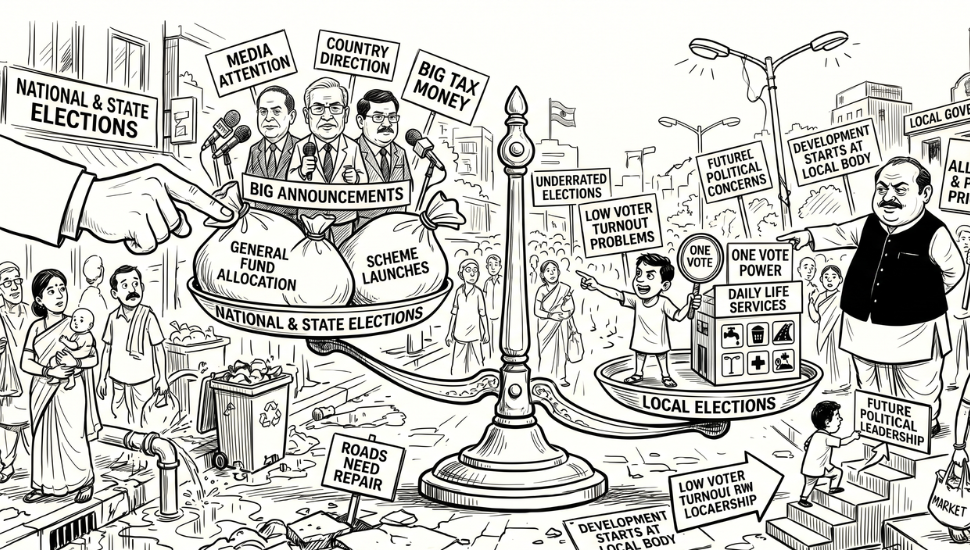
Local Elections vs General Elections — One Governs the Country, One Governs Your Life
General / State Elections
- Shapes national policy and law
- Decides the economy’s broad direction
- High media coverage and turnout
- Impact felt over years and decades
- Governs through institutions and ministries
Local Body Elections
- Shapes your neighbourhood’s infrastructure
- Decides your road, water, and waste services
- Low media coverage, low turnout
- Impact felt within weeks and months
- Governs through direct service delivery
Think of it this way. A general election decides who steers the ship of state. A local election decides whether the road to the port is paved, whether the harbour has functioning lights, and whether the fish market is clean enough to operate.
Both matter. But one of them is invisible to most citizens — and that invisibility has consequences.
General elections capture the imagination because the stakes feel grand. But the government closest to you — the one most reachable and most directly accountable — is local. Ignoring it is like obsessing over the design of a building while ignoring the foundation it stands on.
Your Vote Carries More Weight Than You Think
Here is something that is mathematically true and rarely discussed. Your individual vote has far more influence in a local election than in a national or state election.
A national parliamentary constituency might have one to two million registered voters. Your vote is one in two million. The chances that your single vote decides the outcome are vanishingly small — not zero, but close enough to feel negligible.
A ward constituency in an urban local body might have twenty thousand voters. In many cities, local elections are regularly decided by margins of two hundred to five hundred votes. There are recorded cases of local elections decided by fewer than fifty votes.
Your individual vote in a local election is fifty to a hundred times more powerful than the same vote cast in a national election. This is not rhetoric. It is simple arithmetic.
And yet turnout in local elections is consistently lower than in national elections. The election where your vote is most powerful is the election where most people choose not to vote. That is arguably the single strangest inversion in democratic behaviour.
Political Parties Take Local Elections More Seriously Than Voters Do
Here is the irony. While ordinary voters ignore local elections, political parties pay close attention to them. They have good reason to.
Local elections are the earliest indicator of public sentiment before major state or national polls. A party that performs poorly in municipal and panchayat elections takes that as a warning signal for what is coming. One that wins strongly uses local bodies to build a ground-level network of party workers, loyalists, and local influencers.
But there is something even more important. Local bodies are where political careers begin. The ward councillor of today is often the MLA of tomorrow, the MP of the day after, and occasionally the cabinet minister or chief minister of the generation to follow.
Almost every significant political leader in India — and in most democracies — started in local politics. They learned governance, built voter bases, and established credibility at the ward or panchayat level before rising higher.
This means that local elections are literally selecting the future leadership of states and nations. The person you vote for — or fail to vote against — in a ward councillor election today may shape policy at the state or national level a decade from now.
Parties understand this. They invest in local elections strategically. Voters do not — and that asymmetry shapes outcomes in ways that compound over time.
The Hidden Factor Most People Miss
Local elections are not just about civic administration. They are about who controls the future. Every local election shapes three things simultaneously: the careers of future political leaders, the development priorities of neighbourhoods for the next decade, and the grassroots power structures that determine who can mobilise people and resources in any future crisis. When you skip a local election, you are not just leaving a pothole unfixed. You are helping decide who holds power — at every level — for a generation. The candidate who wins your ward today will have contacts, credibility, and a voter base that they carry forward. The networks built through local elections are the infrastructure of political power itself.
Low Voter Turnout: Who Benefits, Who Loses
When most people stay home during local elections, a predictable dynamic takes over. Small, tightly organised groups gain disproportionate control over outcomes.
These might be factions aligned to a specific religious community, a caste group, a trade association, a real estate lobby, or a construction contractor network. Any group that can reliably deliver even a few thousand votes in a low-turnout election can effectively control who wins.
This is not a conspiracy theory — it is simple electoral mathematics. If only fifteen percent of registered voters turn out, a candidate needs just eight percent of total registered voters to win. Any organised interest group that delivers that eight percent gets to pick the councillor, the committee chair, the person who approves contracts and decides project priorities.
The consequences play out in local budgets. Projects that benefit the councillor’s backers get prioritised. Infrastructure in neighbourhoods that did not vote for the winner gets delayed. Contracts go to connected parties. Civic grievances from unorganised residents receive less attention.
Low turnout is not neutral. It is a redistribution of power — away from the general population and toward organised narrow interests. Every citizen who does not vote in a local election is effectively donating their democratic influence to whoever does show up.
Taxpayers Are Funding Projects They Have No Say Over
Local governments collect and spend significant public money. Property taxes, water charges, local levies, and transfers from state and central government all flow through local bodies. These funds pay for roads, drains, parks, public lighting, markets, and community facilities.
As a taxpaying citizen, you contribute to this pool. But your ability to influence how that money is spent depends almost entirely on local elections. The elected representatives you choose — or fail to engage with — determine where the budget goes, which projects get green-lit, and how public funds are managed or mismanaged.
Most citizens follow national budgets closely. They debate income tax slabs and infrastructure spending at the union level. But they pay almost no attention to the local body budget that directly funds or defunds the infrastructure in their own neighbourhood.
It is the equivalent of carefully reading the annual report of a company you have invested in, while completely ignoring the day-to-day operations that determine whether the business actually functions.
Why Ignoring Local Elections Is Getting More Costly
The consequences of weak local governance are becoming more visible, not less. Urban India is facing a cluster of challenges that are fundamentally local in nature: flooding during heavy rains due to inadequate drainage, water shortages in cities that have growing populations and ageing pipelines, waste management crises in cities that lack functional systems, air quality problems worsened by poor planning and unregulated construction, and traffic congestion caused by infrastructure that has not kept pace with growth.
None of these can be solved from Delhi or the state capital alone. They require competent, accountable, well-funded local governments with clear mandates and strong civic pressure to perform.
The era of urbanisation we are living through makes local government more important than at any point in Indian history. By 2047, a majority of India’s population is expected to live in urban areas. The quality of those urban environments — whether they are liveable, sustainable, and equitable — will be determined almost entirely by local governance.
The cities of the future are being built by the local governments of the present. Those governments are being elected — or ignored — right now.
The Government Closest to You Matters Most
National elections decide who governs the country. State elections decide who governs the state. Local elections decide how your everyday life actually functions — the road in front of your door, the water in your tap, the park your children run in.
The government closest to you is the one with the most direct power over your daily experience. And in most democracies, it is the government chosen by the fewest people.
That is not a coincidence. It is a gap — between who these elections affect and who bothers to participate in them. The people who understand this and show up are the people who, quietly and consistently, shape the places where the rest of us live.
The next time a local election is announced in your city or village, treat it like the national election you would never miss. Find out who is running. Understand what they are promising on drainage, water, waste, and roads. And vote — not as a civic duty, but as the most efficient democratic act available to you.
Your ward councillor election is the one vote where you genuinely, measurably matter.