Blog post: Why are women-focused welfare schemes increasing?
Governments aren’t suddenly becoming feminist. They’re becoming pragmatic. Women-focused welfare schemes are rising — not because of moral awakening, but because the economics, the votes, and the politics all now point in the same direction.
Women-focused welfare schemes — cash transfers, free cooking gas, subsidised loans, housing grants, free bus passes — are multiplying faster than ever. In India, Brazil, Mexico, Kenya, and across Europe, governments of every stripe are directing money and benefits specifically toward women.
Most people assume this is a sign of progress. That governments finally care. That feminism has won a policy battle. But that reading is too generous — and too simple.
The real story is more interesting. It mixes cold electoral math, decades of development economics research, demographic shifts, and a global race to look good on gender indices. Understanding why these schemes are multiplying tells you a lot about how modern governments actually make decisions.
The Politics of Targeted Welfare
Welfare is never just welfare. It’s a signal. It tells a voter: the government sees you, and the government is on your side.
Women now make up a majority or near-majority of registered voters in most democracies. In India, women’s voter turnout crossed men’s in 2019. In the United States, women have outvoted men in every presidential election since 1980. In Brazil, women represent about 53% of the electorate.
That’s not a social statistic. That’s a political opportunity.
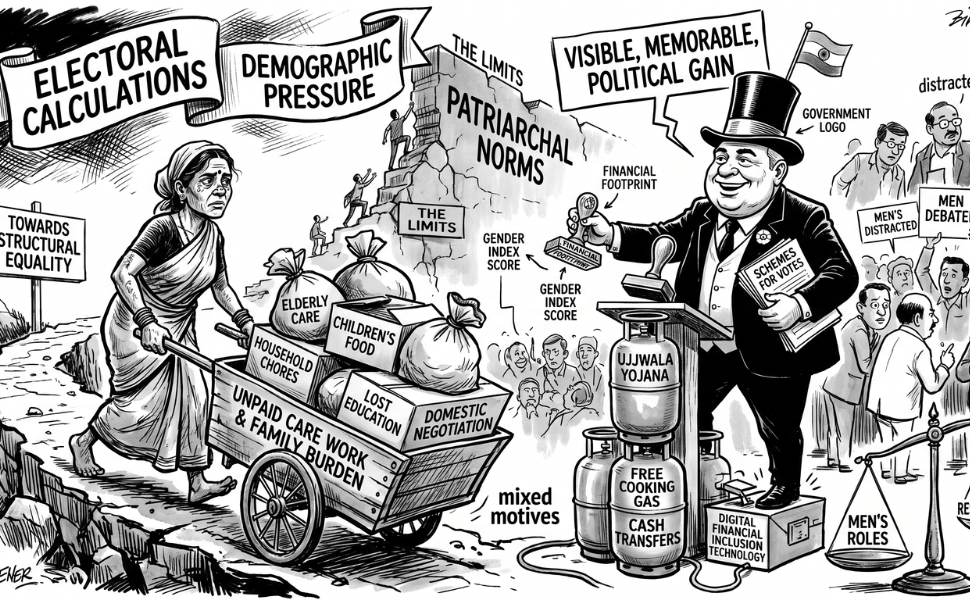
Politicians have noticed. Direct benefit transfers, free cooking gas, free bus rides — these are schemes designed to be visible, personal, and memorable. A woman who receives a gas cylinder with a government logo on it knows exactly who gave it to her. That’s far more powerful than an abstract subsidy buried in a budget line.
The political genius of women-targeted schemes is their precision. You are not giving money to “the poor” — a vague category that spreads credit thin. You’re giving it to women. A defined, large, and increasingly electorally active group.
Economics Made the Case First
Long before politicians discovered the electoral logic, economists discovered something remarkable. When you give money or resources to women — rather than to households in general or to men — better things happen.
UNICEF and the World Bank have documented this across multiple countries. Women spend a higher proportion of income on children’s health, education, and food. The consumption patterns differ sharply from men. A dollar in a woman’s hands is not the same as a dollar in a man’s hands — not because of gender stereotypes, but because of the social roles women typically occupy and the responsibilities they carry.
Research from Brazil’s Bolsa Família programme found that children in households where mothers received transfers had better school attendance and lower child malnutrition rates than those where transfers went to fathers.
This research accumulated over 30 years. By the 2000s, it had become conventional wisdom in development economics. International institutions — the IMF, World Bank, UNDP — began formally recommending that cash transfers and welfare programmes route payments through women wherever possible.
Governments in the Global South, which have long depended on international development funding and policy advice, absorbed this logic. And it spread. Women-focused welfare became not just compassionate policy — it became evidence-based policy. That gave it credibility across ideological lines.
Demographic Pressure and Unpaid Labour
There’s a structural reason these schemes are rising now, specifically. The world’s population is ageing. Families are getting smaller. And the enormous burden of unpaid care work — looking after children, the elderly, the sick — still falls overwhelmingly on women.
Governments are waking up to a crisis they helped create. Decades of cutting social services meant that informal care — mostly done by women, for free — plugged the gap. Women left jobs. Women delayed education. Women accepted financial dependence because the alternative was leaving a parent or child without care.
Women-focused welfare schemes are partly a belated recognition of this debt. Free bus passes for women. Cash transfers for mothers. Pension supplements for women who took career breaks for caregiving. These are governments admitting — in the language of policy — that society extracted unpaid labour from women and owes something in return.
But the recognition is still incomplete. Most schemes compensate women for their caregiving roles without challenging those roles. They make the burden slightly lighter — they don’t redistribute it.
Global Frameworks Created Political Cover
In 2015, the United Nations launched the Sustainable Development Goals. SDG 5 called for gender equality. Every signatory government was now on record committing to it.
This matters more than it seems. International frameworks give domestic politicians permission to act. A minister pushing for women’s welfare schemes can now point to global commitments. “We signed the SDGs.” “We are meeting our Gender Parity Index targets.” The global framework becomes political armour.
At the same time, international rankings became politically significant. The World Economic Forum’s Global Gender Gap Index ranks 146 countries. No government enjoys being called out for poor performance. Women-targeted welfare programmes are visible, measurable, and improve scores. Governments have an incentive to launch them — not because the ranking truly matters, but because the ranking is reported in newspapers and used by opposition parties.
There’s something slightly cynical here. A government can launch a high-profile women’s welfare scheme, get credit in the Gender Gap Index, and still fail on equal pay, workplace harassment laws, or women’s political representation. Schemes are easier than structural reform. That’s partly why they proliferate.
Populism Found Women-Focused Policy Useful
Something else changed in the 2010s. Populist politics — on the left and the right — discovered welfare as a tool for consolidating power quickly.
Traditional welfare is slow. Building hospitals takes years. Training teachers takes years. Improving infrastructure is invisible to voters for a long time. But a direct cash transfer to a woman’s bank account? That lands in weeks. She feels it immediately. She knows who sent it.
Populist governments from Narendra Modi’s India to Jair Bolsonaro’s Brazil to Andrés Manuel López Obrador’s Mexico all launched women-focused welfare schemes. The ideological differences between these leaders are vast. But the technique is the same: identify a large, sympathetic constituency; deliver a tangible, visible benefit; attach your name and face to it.
India’s Pradhan Mantri Ujjwala Yojana (free cooking gas for women below the poverty line) enrolled over 90 million households. The gas cylinders carried the government’s branding. It was welfare and advertising at the same time. The same logic runs through Mexico’s Sembrando Vida and Brazil’s expanded Bolsa Família.
This isn’t an argument that these schemes are bad. Most of them genuinely help. But understanding the populist motive helps explain the pace and scale of proliferation — and why governments that disagree on almost everything agree on this.
The deepest driver isn’t ideology or economics — it’s the digital financial inclusion revolution. When governments gained the technical ability to send money directly to individual bank accounts (via Aadhaar in India, M-Pesa in East Africa, PIX in Brazil), women-focused transfers became operationally possible at scale for the first time. The schemes proliferated not just because governments wanted to help women, but because they suddenly could — cheaply, quickly, and with proof. The technology enabled the politics.
Why It Matters: The Modern Impact of Women-Focused Welfare
The rise of women-focused welfare schemes has real, measurable effects — and real limits.
On the positive side: financial inclusion for women has expanded significantly. Millions of women who never had a bank account now have one, because the welfare transfer required it. That’s an economic foothold. It builds credit histories. It creates independence. In deeply patriarchal societies, a woman receiving money in her own name — not her husband’s — is a quiet but significant shift in household power.
Studies from programmes across South Asia and Sub-Saharan Africa show reduced domestic violence in households where women control welfare transfers. Money is leverage. Women with resources have slightly more ability to negotiate, resist, and leave dangerous situations.
But the limits are real too. Most schemes target women as mothers and caregivers — not as workers, citizens, or individuals with rights. The framing matters. When the state gives you money because you are a mother, it reinforces the idea that motherhood is your primary social role. The more transformative move — equal wages, equal political representation, institutional childcare — remains far harder and far rarer.
Women-focused welfare schemes are also vulnerable to politics. They appear quickly under populist governments. They can disappear just as quickly when budgets tighten or when a new government wants to rebrand. A scheme tied to a leader’s personal image is not a secure entitlement. When the leader goes, the scheme can follow.
The rise of women-focused welfare schemes tells a coherent story when you see all the threads together. Electoral arithmetic pushed politicians toward women as a target group. Development economics gave them the justification. Digital infrastructure gave them the delivery mechanism. Global frameworks gave them the optics. And populist politics gave them the urgency.
None of this is pure altruism. But mixed motives don’t invalidate good outcomes. A scheme that puts money in a poor woman’s hands because a politician wants her vote still puts money in her hands.
The question worth asking is what comes next. Welfare schemes are a floor — they prevent the worst. But structural equality requires something harder: changing who controls land, who sits in boardrooms and parliaments, who does the unpaid work, and who makes the rules. The schemes are multiplying. The deeper changes are not.
“Governments are giving women more money. They are not yet giving them more power. Watch the gap between those two things — that’s where the real story lives.”